
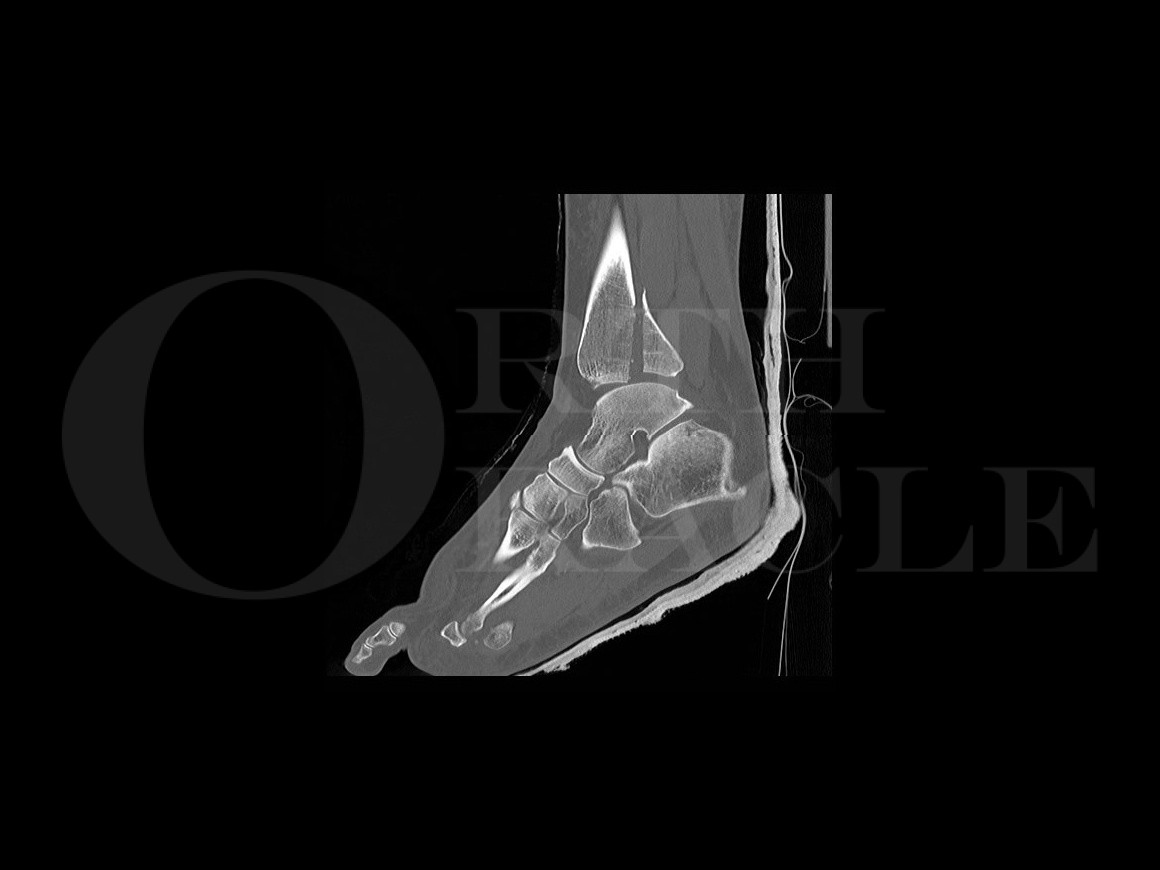
Learn the Ankle fracture: Postero-lateral plating of pronation-external rotation ankle fracture (posterior malleolus)) surgical technique with step by step instructions on OrthOracle. Our e-learning platform contains high resolution images and a certified CME of the Ankle fracture: Postero-lateral plating of pronation-external rotation ankle fracture (posterior malleolus)) surgical procedure.
Most ankle fractures are stable meaning that, under physiological loading, the bony and ligamentous stabilisers of the ankle joint are sufficiently intact allowing normal positioning and motion of the talus in the mortise. Stable ankle fractures do not require surgical treatment.
Some unstable fractures can be reduced and held in a suitable cast such that the reduction is maintained whilst fracture union takes place. However, achieving and maintaining reduction in some ankle fractures is not possible and it is these unstable fractures that require internal fixation. Medial injuries such as deltoid ligament or medial malleolar fractures often impact upon fracture stability. Posteriorly, fractures of the posterior tibial plafond or posterior malleolus are often associated with unstable fracture patterns. Laterally, a proximal fibula fracture or evidence of disruption of the distal tibio-fibular syndesmosis are often features seen in unstable ankle fractures.
Orthopaedic trauma dogma has previously taught that the indication to fix a posterior malleolar ankle fracture is determined by the size of the fragment (oft quoted as 25-33% of the AP dimension). The real indication for fixation of these fracture fragments is to restore stability to an unstable fracture pattern. Quite often it is clear that the presence of a large fragment is an indication but the other reason for restoring stability by fixing these fragments is to reverse the pattern of injury especially in a dislocation.
In my hands, the posterolateral approach is the workhorse to fix these fractures but significant propagation of the fracture lines into the medial malleolus may necessitate a separate posteromedial approach. Both of these approaches allow anatomic reduction of the joint surface and the application of appropriate fixation. It is for this reason that I never use screws placed from anterior to posterior.
In this case, a 48-year old female sustained a closed injury to her right ankle after slipping. She sustained a closed, pronation external rotation ankle fracture pattern and her soft tissues were in good health when taken to the operating theatre within 24 hours of injury.

INDICATIONS
An acute, unstable, fracture of the ankle that is either irreducible or where maintaining a stable reduction by closed methods is likely to be unsuccessful.
SYMPTOMS & EXAMINATION
The patient will present with pain and swelling. In an unstable ankle fracture, the patient is unable to bear weight. In a clear ankle fracture-dislocation, the patient will have an obvious deformity of the ankle. The soft tissue envelope may be compromised either with an open wound (usually located medially) or skin blanching and blistering. Manipulation and reduction of a clear fracture-dislocation and application of back slab cast is mandated to provide temporary immobilisation.
In the presence of an open wound, urgent wound toilet, administration of appropriate antibiotics, and sterile dressings should be applied. The tetanus toxoid status of the patient should be noted and appropriately acted upon. Any blisters should also be dressed with non-adhesive dressings. Manipulation and reduction of the fracture should then be performed and a temporary cast applied whilst plans are made for urgent debridement and temporary external fixation in an operating theatre. Realistically, these fractures can be fixed up to 3 weeks from date of injury but instead of evacuating a fresh haematoma like operating within the first few days, the soft callus needs removing from in between the fracture fragments and mobilisation of the fracture is more tricky. In addition, the satisfying clunk of reducing the posterior malleolus is less evident.
IMAGING
Plain radiographic assessment should be the initial mode of imaging. Two standard orthogonal views should be taken. My personal view, and that of my colleagues in Sheffield, is that a CT scan is mandated in the following three ankle fracture scenarios:
Any history of dislocation
Suspected syndesmotic injury
Evidence of posterior plafond involvement
A CT is particularly helpful in demonstrating the pathoanatomy of the posterior malleolus according to the Haraguchi classification. This aids in planning surgical approach and methods of fixation. CT will also identify any intercalated “dye punch” fragments that may impede reduction necessitating reduction or excision. MRI may be of limited benefit but can help in assessing concurrent ligamentous injuries. The identification of a posterior malleolar fracture fragment and its associated pathoanatomy means that a postero-lateral approach to fix this fragment may be warranted. An associated fibula fracture can be accessed through the same surgical wound with ease.
ALTERNATIVE OPERATIVE TREATMENT
There are many methods of applying internal fixation to the many variations in fracture patterns. In a pronation-external rotation ankle fracture pattern, a posterior malleolar fracture fragment is a common feature. The Association for Internal Fixation (ASIF)/Arbeitsgemeinschaft fur Osteosynthesefragen (AO) group ) used to instruct indirect reduction methods for this fracture fragment with internal fixation provided by anterior to posterior part-threaded screws. This technique is possible for some fracture fragments but malreduction is difficult to mitigate against and can be difficult to interpret from fluoroscopic imaging. Certainly, the biomechanics of this fixation method are inferior to direct reduction and buttress plating.
External fixation or fine wire fixators may be used as definitive operative treatment methods but, in my opinion, this is rarely indicated other than in situations where the soft tissues are in poor health or in cases of polytrauma that never become fit enough for definitive fixation.
NON-OPERATIVE MANAGEMENT
By and large, unless the patient is insufficiently fit for surgical treatment, open reduction and internal fixation is warranted in unstable and poorly stabilised ankle fractures. If a patient is medically unfit for ORIF then cast treatment may be considered.
CONTRAINDICATIONS
Be very aware of the red, swollen and unstable foot with little pain. This presentation should raise the suspicion of a neuropathic foot undergoing a Charcot process. Whilst fixing an ankle fracture in the presence of neuropathy is not a contra-indication, it is important to distinguish between this clinical situation and a Charcot process. It may be most appropriate to treat suspected Charcot processes affecting the ankle with offloading and total contact casting.
It is never wise to make surgical incisions through blistered skin. In these instances, it is better to wait for the soft tissues to heal which may be aided by appropriate immobilisation in a cast or monolateral external fixator.

In my practice, planning a postero-lateral approach to the ankle means positioning the patient prone on the operating table. In so doing, be aware that fixing the medial malleolus is less easy because an assistant is required to bend and hold the knee at 90 degrees. The anaesthetist may also be less keen on positioning prone because of airway management and potential ventilatory compromise. Some surgeons advocate placing the patient in a “sloppy lateral” position which allows the surgeon to perform a postero-lateral approach and permits easier access to the medial malleolus. Alternatively, if placing the patient fully prone, in order to fix the medial malleolus, the patient can be turned supine after closing the posterior wound and applying a temporary, sterile dressing.
Fluoroscopy should be available with an image intensifier and a trained radiographer.
Appropriate antibiotics are administered and a thigh tourniquet and exclusion drape are applied. The limb is prepared with Chlorhexidine from toes to the tourniquet. It is important that the surgical drapes are also placed above the knee to allow the knee to flex to 90 degrees when fixing the posterior malleolus.


In all cases, the patient is placed in a below the knee back slab for the first two weeks after surgery. At two weeks, the wounds are inspected and re-dressed. In unreliable patients a complete, lightweight below-the-knee cast is applied for a further four weeks and weight bearing is not permitted for the first six weeks after surgery. Anecdotally, I find the postero-lateral wound heals well as it rarely traverses skin that has been previously blistered. It is important not to impair wound healing by consciously avoiding the use of self-retaining retractors during the surgical procedure.
In trustworthy patients, at two weeks I prefer to apply a removable lightweight cast. This can be removed by the patient and ankle range of motion exercises can be commenced together with touch weight bearing as advised by the physiotherapist. This latter regime, permitting ankle range of motion, allows nourishment of the articular surface and may well reduce the risk of thrombi-embolic events.
In my practice, rivaroxaban is prescribed for the duration of cast application to prevent thrombo-embolic events.
At six weeks, in all patients weight bearing starts in normal shoes and invariably patients will require physiotherapy input to improve ankle range of motion.
In terms of post-operative imaging, I routinely take plain film imaging of simpler fracture patterns at 6 weeks. There is certainly merit in performing post-operative CT to check reduction in more complex fracture patterns especially if the posterior fixation forms part of internal fixation for a pilon fracture.

Buttress plate stabilisation of posterior malleolar ankle fractures: a familiar technique through an unfamiliar approach. MR Carmont, MB Davies. Current Orthopaedics 2008; 22(5): 359-364.
This educational paper compares the postero-lateral approach to the ankle with the anterior Henry approach to the distal radius and is designed to give surgeons confidence in employing the familiar wrist approach in an analogous manner to the ankle.
Pathoanatomy of posterior malleolar fractures of the ankle. Haraguchi N, Haruyama H, Toga H, Kato F. J Bone Joint Surg Am 2006; 88(5):1085-92.
This is the first CT classification of posterior malleolar fractures. It is an excellent paper because it highlights the need for surgeons to understand the pathoanatomy and apply that understanding to their surgical approach. It should be noted that it is the type 2 injuries that have been shown to be most frequently under-estimated in the clinical setting leading to poor management and outcomes.
Posterior malleolus fractures: worth fixing. Solan MC, Sakellariou A. Bone Joint J 2017; 99-B(11):1413-1419.
This excellent and current paper is written by two renowned experts in the management of ankle fractures. It is a clear and concise review of the literature regarding the posterior malleolus fracture and provides cogent and rational arguments about how to manage them.
Reference
- orthoracle.com


