
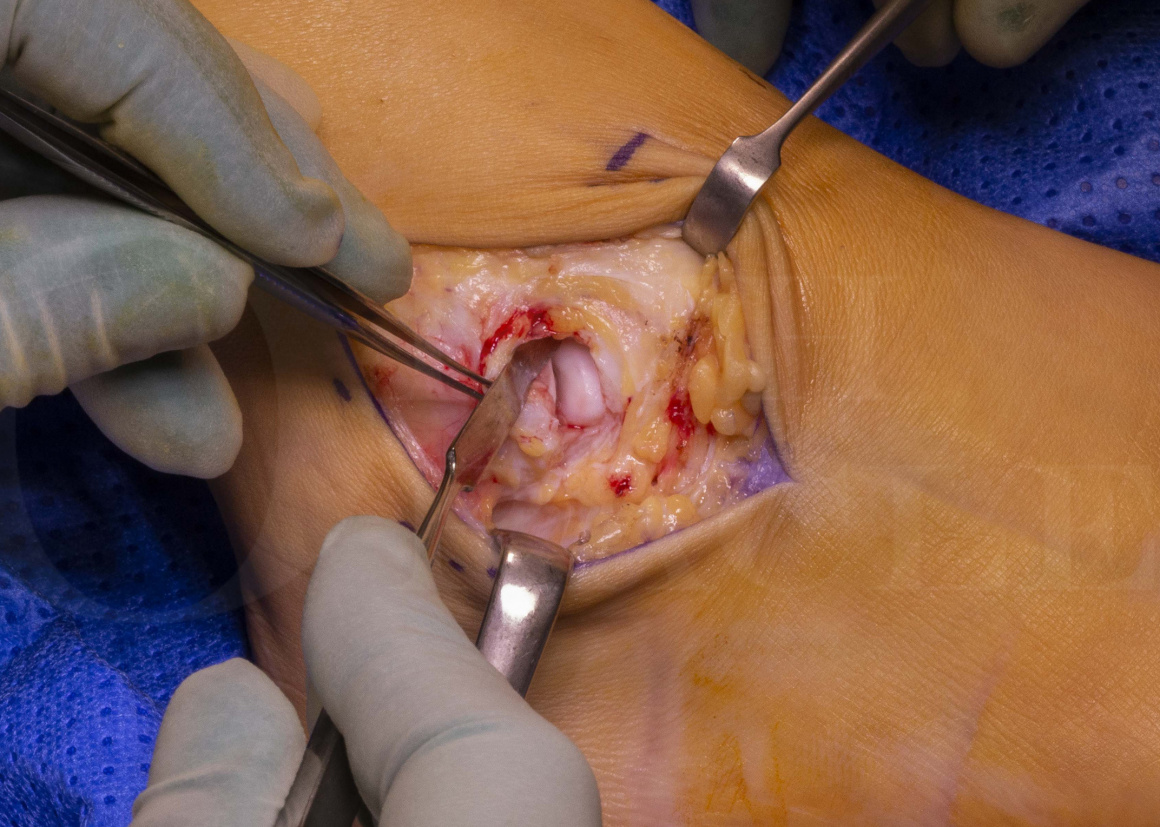
Learn the Broström lateral ankle ligament (mid-substance) repair surgical technique with step by step instructions on OrthOracle. Our e-learning platform contains high resolution images and a certified CME of the Broström lateral ankle ligament (mid-substance) repair surgical procedure.
Chronic ankle instability is a potential sequel to acute ankle sprains and refers to persistent giving way of the ankle. There are a number of causes of ankle instability including structural instability, functional instability and pseudo-instability. Functional instability describes an instability that is secondary to a proprioceptive deficit Functional instability is most effectively addressed with an appropriate physiotherapy lead rehabilitation programme, to restore proprioception and coordination. Pseudo-instability is a feeling of instability in the ankle; In pseudo-instability the ankle usually doesn’t give way completely, individuals are often able to protect the ankle before it gives way and they might complain of a consistent feeling of catching or discomfort prior to the ankle giving. Pseudo-instability is usually caused by pain generators such as loose bodies or osteochondral lesions of the ankle.
Structural instability refers to an instability that is secondary to laxity of the ankle ligaments, usually the anterior talo-fibular (ATFL) and the calcaneo-fibular ligament(CFL). Structural instability is characterised by an increased excursion of the talus relative to the ankle mortise. At initial presentation, many patients with structural instability will have a degree of functional instability as well. The functional element of instability should be addressed with a course of functional rehabilitation with a physiotherapist before addressing the structural element. Even patients with significant structural instability may compensate satisfactorily by improving the functional component of their instability.
Those patients with persistent structural instability, despite adequate physiotherapy, may benefit from surgery to stabilise the ankle, which aims to address the structural component by repairing or re-constructing the ATFL and CFL.
One surgical technique that provides excellent results was first described by Brostrom in 1966, whereby the ATFL and CFL are repaired under tension. Gould in 1980 described a modification, incorporating an additional imbrication of the inferior extensor retinaculum (IER). The Bröstrom-Gould technique forms the mainstay of anatomic ankle reconstruction techniques, not only because of the high success rates, but also because of low rates of complication, such as ankle stiffness, subtalar arthritis and nerve injury. The procedure also restores the normal kinematics of the joint. Unlike the anatomical repair, non anatomical reconstructions(such as the Chrisman-Snook or Evans procedure) may not restore normal kinematics of the joint and usually involve larger dissections with a higher complication rate, most notably nerve injury and subtalar stiffness.
Readers will also find the following OrthOracle surgical techniques of interest:
Brostrom lateral ligament reconstruction using JuggerKnot soft tissue anchor(Zimmer-Biomet).
Lateral ankle ligament reconstruction
Ankle arthroscopy using the Smith and Nephew Guhl non-invasive ankle distractor
Peroneal sheath reconstruction (for peroneal tendon subluxation)

INDICATIONS
The primary indication for ankle ligament repair is a persistent giving way of the ankle in the presence of structural instability, that has not responded to a course of functional rehabilitation.
Patients are usually encouraged to undergo three months of intensive functional rehabilitation including strength and proprioceptive training of the ankle and proximal kinetic chain.
SYMPTOMS & EXAMINATION
Patients complain of the ankle giving way. With true instability there is little warning and they will often not be able to catch themselves before the ankle gives, they may experience some pain after the ankle gives way. There is usually a degree of anxiety when walking on uneven ground especially in poorly lit environments. True instability should be separated from pseudo-instability. With pseudo-instability, patients feel that their ankles give way on a more intermittent basis, usually this is caused by a pain generator within the ankle. The patient, when carefully questioned will describe pain or catching within the ankle before it gives and they describe a need to take pressure off the ankle before it gives way. The association with walking on an even ground or in poorly lit environments is much less tangible, and the giving way is more intermittent in nature. With the patient seated, palpation may reveal tenderness that may raise the suspicion of an intra-articular pathology.
Examination should involve inspection, palpation, testing of power and special tests. Patients will often walk with a normal gait, however, with gross instability may be cautious. There may be tenderness over the lateral side of the ankle there is sometimes swelling or puffiness over the anterolateral aspect of the ankle. Patients with functional instability may find it difficult to activate the peroneal tendons. Some patients may even be able to demonstrate peroneal tendon subluxation or it may be inferred by a positive apprehension test.
Testing for true instability is most meaningful when each specific test is compared to the contralateral side. The main tests used are the anterior draw and inversion test. The ATFL is taught with the ankle in 40° of plantarflexion, the knee should be flexed to remove any resistance from the gastrocnemius-soleus complex, the hind foot is held with one hand while the tibia is stabilised and a gentle anterior draw with slight internal rotation of the talus within the ankle mortise is performed. There is a feeling of increase movement within the ankle and a ‘suction sign’ is sometimes visible with the increased movement. The anterior draw should be tested on the opposite side if normal. The test becomes increasingly sensitive with practice.
The inversion test is performed To test the CFL ligament; the CFL ligament is tight with the foot dorsiflexed to plantigrade, in this position, the CFL passes perpendicular to the subtalar joint. The foot can be rested on the examiners forearm while the heel is firmly gripped in his palm, the other hand is used to stabilise the talus and the tibia and the index finger and thumb held over the talar neck; the heel is then inverted inwards and again compared to the opposite side. An increase movement represents a positive test and sometimes the talus it self can be felt to tilt within the ankle mortise.
IMAGING
Plain radiographs are mandatory in assessing the chronically sprained ankle, they help identify associated fractures, avulsions, widening at the syndesmosis, talar-shift, talar-tilt, degenerative change in the ankle or hindfoot and associated loose bodies or impingement lesions. The lateral x-ray can be performed slightly obliquely to pick up anterior osteophytes. With the weight-bearing images varus deformity of the hindfoot can be appreciated which is a factor that may need to be taken into account.
Stress radiographs can occasionally be helpful in assessing laxity in the small number of cases, where clinical signs and symptoms and imaging are equivocal. In my practice stress imaging rarely adds to diagnosis and management.
MRI scanning is helpful in assessing the presence of injuries to the ATFL and CFL as well as the deltoid complex and syndesmosis. Although the presence of injury to these ligaments does not necessarily extrapolate to the presence of instability. Scans are also helpful for identifying associated interarticular pathology such as loose bodies, osteochondral lesions, impingement lesions, osteophytes, and chondropathy. The peroneal tendons can be assessed for tears and splits, as well as evidence of peroneal retinacular injury and peroneal subluxation.
ALTERNATIVE OPERATIVE TREATMENT
The Broström Gould repair is a direct anatomical repair. Alternatives to an anatomical repair include arthroscopic repair, ankle ligament reconstruction using auto graft, for example a slip of peroneus longus, hamstrings, or allograft or a synthetic graft. Reconstructions nowadays tend to be anatomical, with the non-anatomical repairs, such as the Evans, Chrisman Snook and Watson-Jones procedures being largely consigned to history.
Ligament reconstructions generally involve routing of donor ‘ligament’ into bone tunnels positioned in the talus, fibula and calcaneus to mimic the axes of the ATFL and CFL and secured with interference screws. In the main, these are excellent options for failed Brostrom-Gould procedures, in patients with a high BMI or in those with significant hindfoot varus.
Several augments are available such as the internal brace, which is a thick fibre tape, however it is important to understand that these protect the repair as opposed to offering a distinct alternative procedure. Arthroscopic Brostrom procedures have also gained some traction but they technically challenging, with a steep learning curve and their results lack longer term follow up, have not been shown to be better than open techniques with some authors reporting higher complication rates.
NON-OPERATIVE MANAGEMENT
Prior to surgery is imperative that patients undergo a course of functional rehabilitation to work on range of movement strength of the ankle muscles and proprioception as well as work on the proximal kinetic chain. Physiotherapy is likely to address the functional elements of instability, but with significant structural instability the ankle may continue to give way.
Specialised taping of the ankle or the use of specifically designed ankle braces may be an alternative to operative treatment; they work by supporting the ankle and preventing it from giving way, whilst they are being worn.
CONTRAINDICATIONS
This operation requires the patient to be actively engaged with their treatment, because the surgery is the first step in a rehabilitation programme. Patients who are incapable of making regular physiotherapy visits post-operatively should not undergo an operation. Logical contra-indications include the presence of active infection, uncontrolled diabetes, vascular compromise compromise to the skin and soft tissues.
Some of the contra-indications to a standard Brostrom-Gould are logical tenets of orthopaedic surgery. For instance, the procedure relies on the need for an individual to respond to proprioceptive training, therefore any neurological compromise that could affect this means that the procedure is unlikely to be successful. The classic Brostrom-Gould is contra-indicated in cases of systemic laxity, where a more robust reconstruction is required, the Chrisman-Snook being one example. It is common sense not to perform soft tissue reconstructive procedures about a joint that is significantly degenerate.

Preoperatively consent should be gained from the patient and the correct limb is marked with an indelible marker.
Setup should allow access to the lateral side of the ankle, if a Broström-Gould repair is being performed in isolation the patient is positioned in a supine position with a sandbag under the ipsilateral buttock. The ankle should be internally rotated so that the lateral malleolus is easily accessible.
In circumstances where an ankle arthroscopy is being performed simultaneously, (which is frequently the case given the high incidence of associated intra-articular pathology with ankle instability), then the setup is as per routine ankle arthroscopy with a thigh bolster and traction, a sandbag underneath the ipsilateral buttock. The traction is removed and leg can either be rotated off the thigh support, or the thigh support removed following the arthroscopy to allow access for the lateral ankle for the Brostrom-Gould repair.
A world health organisation check is performed including confirmation that the correct operation on the correct limb been performed.
An examination under anaesthetic should always be performed with the knee flexed over the side of the table and anterior draw test with the ankle slightly plantar flexed and an inversion test with the ankle in a plantigrade position is performed and the presence or absence of laxity duly noted.
A thigh tourniquet is used, And a watertight drape to prevent pooling of the skin prep underneath the tourniquet. The skin is prepared with alcoholic preparation, we prepare the skin, to above the knee.


Patients are encouraged to elevate the leg once they are in recovery and regularly over the following 10 to 14 days.
The back slab remains in situ, non-weightbearing, Until the first clinical review at two weeks. The plaster should be kept dry.
Oral analgesia is prescribed and should be taken regularly for 72 hours.
Weight bearing is encouraged from 2 weeks tolerated in a functional boot such as the vacoped, or a plaster depending on wound healing.
Early functional rehabilitation and weight bearing has been shown to be associated with improved functional results. Strength and range of movement work alone are insufficient to restore function. Physiotherapy should be commenced early on, where active and passive sagittal plane movement can begin out of the boot along with active eversion of the hindfoot, activation of the peroneal tendons and dorsiflexion of the ankle. Loaded exercises to strengthen the ankle and in line range of movement is permitted.
Mobilisation out of support is not permitted until 6 weeks.
Early rehabilitation phase is performed between 6 and 10 weeks, the goals are to restore strength in the entire limb, to restore full active range of movement and improving gait symmetery. Gentle range of movement exercises and static exercise cycling are helpful tools in restoring movement. Global strengthening exercises include squats, leg presses and flexion/extension curls. and ankle strengthening beginning with isometric work moving through isotonic , and then resistance training. Ankle proprioception should begin with safe balancing exercises targeting the hindfoot, starting with balancing on the floor, followed by unstable surfaces with limited motion such as a pillow. During this phase, gait training should start with straight line walking, adding in turns as static balance improves aiming for figure of 8 walking by approximately 8-10 weeks.
Late stage rehabilitation phase starts between 8 and 10 weeks. Patients should have achieved approximately 90% ankle strength compared to the contralateral side and demonstrate a reasonably symmetrical gait pattern. During the late stage of rehabilitation, unilateral, strengthening begins, with fully loaded unilateral heel raises. Once patients can achieve 25 single heel raises, plyometric work can commence initially bilateral and progressing to unilateral, before slow jogging is introduced whilst slowly increasing time and distance.
Soreness rules are widely used to progress rehab in the late rehabilitation stage, which means that if a new exercise results in persistent discomfort the ankle is rested before a more gradual re-introduction of exercise.
The final phase of rehabilitation is the return to play phase, during which, functional tests are useful. Functional tests include the single-leg hop for distance, triple hop for distance, the vertical jump for height, drop jump, crossover hop, six-metre hop and stair hop tailored to the specific sport. The return-to-sport phase typically falls between 12 weeks and 4 months following surgery. the target is generally ≥90 % in these functional tests compared to the unaffected side.

Reference
- orthoracle.com


