
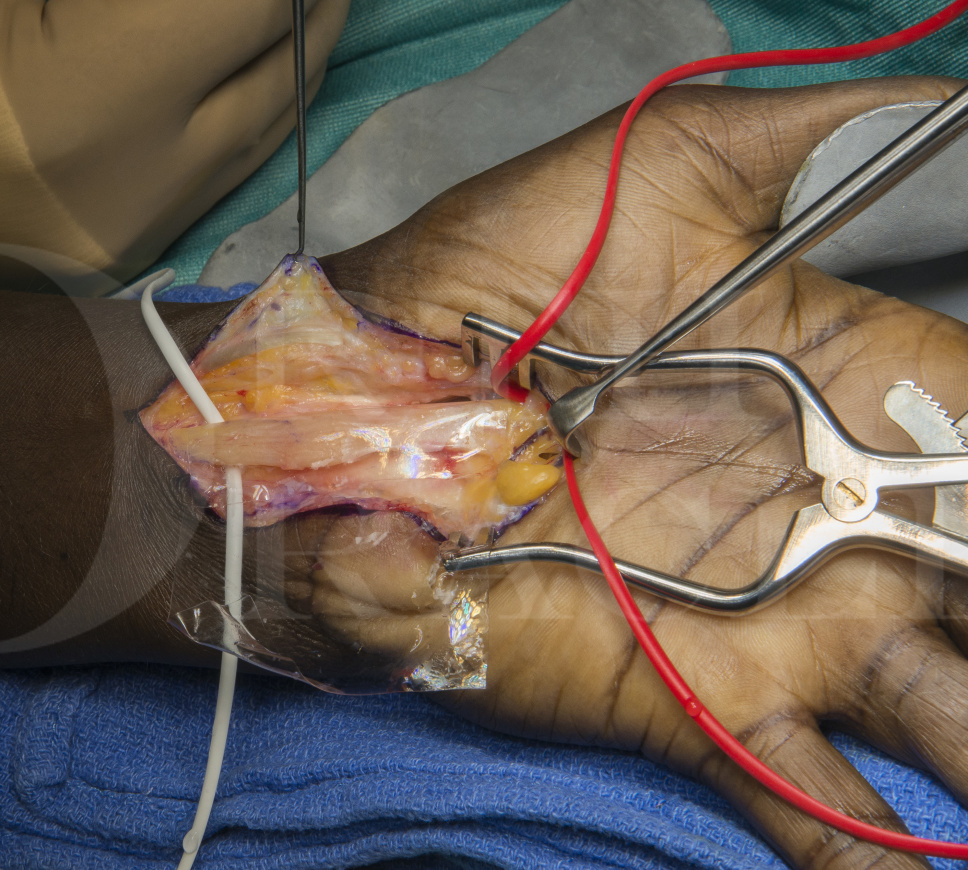
Learn the Carpal tunnel decompression: Revision and application of Polyganics Vivosorb membrane surgical technique with step by step instructions on OrthOracle. Our e-learning platform contains high resolution images and a certified CME of the Carpal tunnel decompression: Revision and application of Polyganics Vivosorb membrane surgical procedure.
Carpal tunnel results from compression of the median nerve on the volar aspect of the wrist. Decompression is a successful operation when performed for the appropriate indication, when the nerve is completely released and when there is no impairment of nerve glide in the post-operative period.
Persistent carpal tunnel symptoms are associated with incomplete decompression and recurrent symptoms after an interval of 3 months or more are usually associated with a degree of scar formation causing further compression or resulting from nerve tether. The rate of failed primary carpal tunnel decompression is approximately 1:20. This figure includes those with significant persistent symptoms or new symptoms after surgery, incorrect diagnosis, contributing concomitant cervical radiculopathy and a failure to manage the patient’s expectations when there is severe nerve dysfunction. The rate of recurrent carpal tunnel syndrome requiring revision decompression within 10 years of the primary procedure is an additional 1:20. Recurrence rates are higher in diabetic patients due to nerve susceptibility to compression and a tendency to develop thickened chronic tenosynovium around the flexor tendons within the carpal canal. Recurrence is also common in women with low body mass index, possibly due to the decreased subcutaneous adipose tissue that otherwise fills the void left after flexor retinaculum (FR) release. The post operative healing in such cases includes rapid reforming of the FR which results in the recurrent compression. Patients with Hereditary Neuropathy with sensitivity to Pressure Palsies (HNPP), a genetic condition, are prone to multiple peripheral nerve compressions and recurrent compression after release. Patients with complications from primary surgery including infection may have impaired nerve glide and develop persistent or recurrent symptoms after primary release.
One of the causes of failed carpal tunnel decompression (CTD) is scarring of the median nerve paraneurium that impairs physiological nerve glide. Revision CTD may require the use of an adjunct barrier to prevent scar formation resulting in recurrent nerve tether. There are a number of biological and synthetic alternatives. The Vivosorb is a bioresorbable polymer layer that can be sutured loosely around a scarred nerve to prevent scar tether in the surgical bed, maintain nerve gliding and prevent recurrence of compression.
Readers will also find the following associated techniques of interest:
Extended approach Carpal Tunnel decompression
Carpal tunnel decompression
Combined median and ulnar nerve decompressions
Median nerve neurolysis, resection and reconstruction using Axogen AVANCE processed nerve allograft

INDICATIONS
Carpal tunnel results from compression of the median nerve on the volar aspect of the wrist. Decompression is a successful operation when performed for the appropriate indication, when the nerve is completely released and when there is no impairment of nerve glide in the post-operative period.
Persistent carpal tunnel symptoms are associated with incomplete decompression and recurrent symptoms after an interval of 3 months or more are usually associated with a degree of scar formation causing further compression or resulting from nerve tether. Revision surgery may require use of an adjunctive barrier to prevent recurrent scar formation. The Polyganics VivosorbTM is a bioresorbable polymer membrane that may be placed around the nerve following neurolysis. The membrane hydrolyses and is reabsorbed over several months, allowing nerve glide without tether from scar that forms in the immediate post-operative period.
SYMPTOMS & EXAMINATION
Carpal tunnel symptoms include paraesthesiae in the thumb, index, middle and radial aspect of the ring finger on the volar surface. Numbness may result from prolonged or severe compression. In severe cases there is wasting and functional loss of the thenar muscles with resultant loss of opposition.
Typical primary carpal tunnel syndrome (CTS) includes night symptoms with waking from sleep and morning numbness or paraesthesiae that may be alleviated with hand shaking or dependency of the affected limb.
Following previous surgery, persistent symptoms suggest incomplete decompression or poor residual function in a nerve that has had severe compression with axonal loss and intra-neural scar formation. Recurrent symptoms after an interval with symptom improvement or resolution suggests that scar has formed around the nerve causing recurrent compression.
Pain exacerbated by passive extension off the fingers or wrist is termed neurostenalgia. This examination finding is suggestive of extrinsic scar that is tethering the nerve and preventing normal physiological glide.
I assess for a Linburg-Comstock anomaly in cases of previous failed carpal tunnel decompression (CTD). The anomaly is a developmental or acquired tether between the flexor pollicis longus (FPL) and the index finger flexor digitorum profundus (FDP) in the distal forearm. In such cases there is chronic inflammation and thickened tenosynovial proliferation as a result of differential glide against the tether point. The overlying median nerve becomes adherent and encased in thickened tenosynovial fibrotic scar as a result and traction neurirtis is experienced during differential tendon action. The symptoms are deep volar radial wrist sharp pain and median nerve “electric shocks” elicited by extension of the index finger with the thumb actively flexed across the palm.
A Tinel’s sign may be elicited in recurrent CTS or failed primary CTD by tapping along the course of the median nerve in a distal to proximal direction. The patient reported “electric shocks” or parasthesiae in the cutaneous territory of the median nerve when the tapping is at the point of maximal scar or compression. This site should be marked with a cross prior to surgery to guide the surgeon to the target area.
IMAGING
Ultrasound imaging may identify impaired nerve glide, a swollen nerve proximal to the compression and abnormal carpal tunnel contents including tumours, ganglia or tenosynovium. In practice I do not usually request imaging because the important features may be elicited through careful and systematic clinical examination.
Magnetic Resonance Imaging (MRI) may be used to identify other pathology around the carpal tunnel or within the carpus. MRI may identify accessory tendon slips in the FPL – FDP index interval. In practice I do not request imaging unless there is some diagnostic uncertainty remaining after the clinical examination.
NEUROPHYSIOLOGICAL INVESTIGATIONS
Neurophysiology studies are essential in the diagnosis of recurrent or failed CTS. I request access to any previous investigations from prior to the primary surgery in addition to previous outpatient records and operation records. The neurophysiology should be repeated to include conducting tin velocity, amplitude, latency and electromyographic (EMG) recording from the thenar muscles.
The severity of the primary CTS diagnosis can be ascertained from the original studies and the repeat will detail any interval improvement, persistence or deterioration. The repeat studies also allow a re-grading of the severity for prognostic reasons.
EMG sampling can identify acute of chronic denervation within the motor axons of the median nerve and any recovery from the prior surgery. In cases with active denervation of the thenar muscles, the motor branch of the median nerve must be identified at surgery and traced through scar and released all the way to where it enters the thenar muscles.
ALTERNATIVE OPERATIVE TREATMENT
The standard approach for failed, recurrent or persistent CTS is a revision CTD with a more extensive approach and external neurolysis of the median nerve. In cases of severe scarring there are autologous flaps that can be rotated and placed around the nerve to cushion it and provide a barrier to further scar formation. Scar at the undersurface of the flexor retinaculum or at the site of the previous exposure can be treated with a pedicled flap of hypothenar fat tissue. The hypothenar fat flap is successful in treating localised scarring but is insufficient when there is extensive scar throughout the course of the median nerve in the distal forearm to the common digital nerve branch points.
Larger autologous tissue flaps include the Becker flap based on the dorsal ulnar artery perforator in the distal forearm. This flap can allow distal pedicled rotation as a “propellor” flap of skin and subcutaneous fat and fascia or fat and fascia alone. The tissue can be placed over the nerve to resurface the nerve or in cases of adipofascial flap alone, the nerve can be loosely wrapped in the flap to prevent tether to skin or the deeper flexor tendons.
A distally-based perforator flap can be elevated from the radial artery in the distal forearm and rotated in the same way with skin and subcutaneous tissues or adipofascial tissues alone. The flap is used in the same way as the B~ecker flap to protect, wrap or resurface the median nerve. The limitation of the radial forearm perforator flap is the proximity to the lateral cutaneous nerve of forearm nerve branches which are close to the radial side of the flap and these branches may be injured or scarred from this approach, creating a new source of nerve pain.
There are alternative commercial devices available for nerve protection after neurolysis. The VivosorbTM is a bioresorbable polymer membrane. ~Collagen barriers are available including the AxoGuardTM nerve protector which is a porcine layered extracellular matrix collagen sheet. This revascularises well and allows restoration of nerve glide. the AxoGuardTM may not be acceptable to some patients due to its animal origin.
All nerve wraps may be associated with recurrent junctional scar at the area where the wrap ends within the surgical bed. tether can occur to the nerve epineurium in the area not covered by the wrap.
NON-OPERATIVE MANAGEMENT
The role of conservative management is limited. Recurrent CTS may be assessed with a response to steroid injection and splint age. However there is poor spread of steroid in the presence of scar and there is a risk inadvertent intraneural injection due to tether of the nerve and adherence to the under surface of the flexor retinaculum. These conservative measures will not bee able to alleviate the constricting scar or scar tether points, but temporarily may reduce symptom severity due to resting the area. Topical massage at the scar can reduce scar sensitivity and allow maturation if collagen in the cutaneous scar. I do not advise prolonged conservative management in the setting of nerve pain, clinical nerve tether and neurophysiological evidence of deteriorating nerve function. In such cases surgery should be recommended and undertaken promptly.
CONTRAINDICATIONS
There are few contra-indications to implantation of a VivosorbTM membrane. A history of previous wound infection is a relative contra-indication. In such cases where there is no active infection, I would counsel the patient regarding the risks and if acceptable then I would cover the implantation with intravenous antibiotics. In cases with recent infection and concern regarding recurrent infection around the implant, then a biological autologous vascularised flap may be indicated.

For cases of revision CTD I use brachial plexus regional block anaesthesia. The block is preformed under ultrasound guidance with a combination of local anaesthetic agents to provide a rapid onset and sustained anaesthesia that provides an extended post-operative block for between 8 and 12 hours. When the block is performed at the level of the upper arm a supplementary subfascial block is required to anaesthetise the skin supplied by the intercostobrachial nerve and the medial cutaneous nerve of the arm. The addition of this block ensures that a pneumatic tourniquet can be placed around the upper arm without discomfort should if be required for more that 60 minutes.
Antibiotics are administered intravenously to cover common skin commensals in advance of the tourniquet insufflation. The antibiotics are used due to the planned implantation of a scar barrier membrane around the nerve.
The regional block allows exploration of the site of revision carpal tunnel decompression with a bloodless field. Additionally, the duration of the block ensures that there is sufficient time for a complete neurolysis of the median nerve and if necessary a tenosynovectomy of the flexor tendons.
A “lead” hand is needed to position the hand for surgery. I use a Mixter to pass sloops around the nerve for retraction. The neurolysis is performed with sharp dissection using a scalpel and multiple blades are needed when there is extensive scar. I would not typically use a nerve stimulator, although it can be of use when there is severe scar around the motor branch to identify the motor branch and any improvement in stimulation thresholds after decompression and neurolysis.
The surgical dissection is performed with loupe magnification. I use a 3x magnification for the exposure and an operating microscope if there is epineural scar to be excised, or when there is a need for internal interfascicular neurolysis in severe cases with “hourglass” constriction of the nerve.
I use a monofilament proline 6’0 suture to secure the VivosorbTM around the nerve at the time of surgery.


The arm is elevated in a Bradford sling and the patient is observed for any bleeding of immediate swelling before discharge later the same day. Simple analgesics are prescribed and the patient os advised to take the first dose as soon as they feel the start of sensation returning to the hand as the brachial plexus block wears off.
The patient is encouraged to mobilise the fingers and to gently mobilise the wrist.
Introduction of light functional use of the hand at 24 hours post-operatively allows nerve glide and prevents tethering to the flexor tendons.
In addition the use of the hand for gripping encourages a natural slight wrist extension which prevents the median nerve becoming tethered in the volar wound.
Sutures are removed at 2 weeks and the patient is reviewed at 6 weeks and 3 months to ensure that there are no complications and that the symptoms have resolved.

The results of primary carpal tunnel decompression are generally predictable and good. Jeremy Bland has documented poorer outcome in cases where there is mild neurophysiological carpal tunnel or severe, perhaps representing diagnostic confusion in the former and severe nerve impairment in the latter. Outcome is less predictable in patients with diabetes and with peripheral neuropathy. Peripheral neuropathy is not a contra-indication to surgery however careful consideration should be given to severe compression cases with little preserved function who remain pain free because occasionally neuropathic pain may develop following decompression. The effects of scar pain and tenderness can be minimised with careful surgical technique avoiding injury to the cutaneous branches in the palm, early functional use of the hand, scar massage and desensitisation. Severe motor dysfunction with loss of thenar bulk does not recover with decompression and adjunctive tendon transfers should be considered in such cases to improve hand and thumb dexterity for opposition grip.
The results of revision CTD surgery are more variable and reflect the diagnostic uncertainty, the nerve dysfunction and the presence of scar in the nerve bed, involving the epineurium and potentially intraneural scar. the reasons for revision need to be defined. Is it a true recurrent compression or is it a nerve tether or perhaps an unrecognised nerve injury.
In persistent or recurrent compression there is approximately a 80% chance of symptom resolution or significant improvement. This is slightly less than the 90-95% successful primary decompression results.
When there are new symptoms following primary release the possibility of a nerve injury renders the outcome less good in this group with 70% of patients benefitting from the revision surgery.
When revision decompression has not resolved the symptoms, a further decompression is successful in only approximately 50% of cases.
I therefore consider using an scar barrier when there is significant epineurium involvement in scar, scar tether or repeat revision surgery cases.
There is insufficient published data to provide comment on efficacy of different scar barriers used in this setting, however the safety profiles of the different devices are good.
My personal experience is of using collagen barriers in revision nerve surgery (more than 90 cases of revision CTD and revision cubital tunnel decompression). I am happy with the results and have only revised one for a post-operative haematoma. The use of the Vivosorb is more limited in this setting but in the cases I have performed to date (less than 10) there is no safety concern and good efficacy. The Vivosorb is useful when there is not significant epineurium scar and also when there is a patient objection to the use of an animal collagen product.
The Vivosorb is also cheaper than porcine collagen nerve wraps.
The Vivorsorb is manufactured from a polylactide of polycaprolactone. There is comprehensive data on the use of this polymer in peripheral nerve repair. The material is available as a Neurolac conduit for bridging small nerve gaps and in a thin walled version (Neurolac TW) for augmenting primary nerve repair or bridging small gaps in nerves at mobile points such as the digital nerves. There is one paper (Nassar 2014) detailing the use in carpal tunnel revision surgery.
Comparative data on revision nerve surgery with simple decompression, nerve wrapping (collagen and bioresorbable polymer) or adjunctive anti-scar agents is needed to define the efficacy and risk profile of each. Based on the response to revision CTD with simple revision decompression alone, the majority of cases benefit without adjunctive techniques (90%) and so identifying an at-risk sub-group should be a key research strategy to target those patients that may benefit with the addition of some enhancement to simple revision decompression alone. In re-revision, the high failure rate suggests that this group would benefit most from the addition of an anti-scar technique. The datasets that would be required to power such an investigational study are large and a multicentre, long duration randomised controlled trial is impractical. Registry data would contribute to the evidence base and help define a future clinical trial.
References:
Levine DW, Simmons BP, Koris MJ, Hohl GG, Fossel AH, Katz JN. A self-administered questionnaire for the assessment of severity of symptoms and functional status in carpal tunnel syndrome. J Bone Joint Surg Am 1993;75:1585-1592
Fowler JR. Nerve Conduction Studies for Carpal Tunnel Syndrome: Gold Standard or Unnecessary Evil? Orthopaedics 2017;40(3):141–142
Kaile E, Bland JDP. Safety of corticosteroid injection for carpal tunnel syndrome. J Hand Surg Eur 2017 Jan 1:1753193417734426. doi: 10.1177/1753193417734426 [Epub ahead of print]
Bland JD. Do nerve conduction studies predict the outcome of carpal tunnel decompression? Muscle Nerve 2001 Jul;24(7):935-40
Bland JD. A neurophysiological grading scale for carpal tunnel syndrome. Muscle Nerve 2000 Aug;23(8):1280-3
Tang CQY, Lai SWH, Tay SC. Long-term outcome of carpal tunnel release surgery in patients with severe carpal tunnel syndrome. Bone and Joint Journal 2017 Oct;99-B(10):1348-1353
Sun PO, Selles RW, Jansen MC, Slijper HP, Ulrich DJO, Walbeehm ET. Recurrent and persistent carpal tunnel syndrome: Predicting clinical outcome of revision surgery. J Neurosurg 2019 Feb 15:1-9. doi: 10.3171/2018.11.JNS182598
Djerbi I, Cesar M, Lenoir H, Coulet B, Lazerges C, Chammas M, Revision surgery for recurrent and persistent carpal tunnel syndrome: Clinical results and factors affecting outcomes. Chir Main 2015 Dec;34(6):312-7. doi: 10.1016/j.main.2015.08.010. Epub 2015 Nov 3
Zieske L, Ebersole GC, Davidge K, Fox I, Mackinnon SE. Revision carpal tunnel surgery: A 10-year review of intraoperative findings and outcomes. J Hand Surgery Am 2013 Aug;38(8):1530-9. doi: 10.1016/j.jhsa.2013.04.024
Nassar WA, Atiyya AN. New technique for reducing fibrosis in recurrent cases of carpal tunnel syndrome. Hand Surg. 2014;19(3):381-7


