///

Ankle Replacement -De Puy Mobility

Learn the Ankle Replacement -De Puy Mobility surgical technique with step by step instructions on OrthOracle. Our e-learning platform contains high resolution images and a certified CME of the Ankle Replacement -De Puy Mobility surgical procedure.
Ankle replacement has been available as an intervention for ankle arthritis since the 1970s. The initial implants were engineered on the assumption that the human ankle joint functioned as a true hinge . They were therefore designed only to allow uniplanar movement (plantar and dorsiflexion) and comprised just 2 components which were mechanically linked. The ankle joints they were implanted into however also functioned with a degree of rotation which had to occur at the weakest point in the “mechanism”. Given the robustness of the implanted ankle hinges this transpired to be the implant/joint interface which therefore led invariably to early implant failure.
The “eureka” moment in ankle replacement came with the introduction of 3 component replacements in which the Tibial and Talar components were linked by a UHMW polyethylene meniscus which allowed an element of rotation to occur within the joint itself as well as providing adequate component stability.
These initial replacements whose results still define what longevity an ankle replacement should attain are the STAR , Beuchal-Pappas and Salto implants. In general their 10 year survivorships are lower than reported for hip and knee replacements but are still in the mid to high 80 percents.
In general terms an ankle replacement will not be recommended for younger and higher demand patients due to concerns of accelerated wear of the implant .

INDICATIONS
–Isolated Ankle arthritis in a well aligned ankle: Generally a replacement is operation for the lower demand and fifty plus age group with limited angular deformity and good soft tissue cover around the ankle and with no history of deep infection or neuropathy. With an ankle replacement the failure rate of most implants (which have been in use for long enough) is 2%/annum which equates to a 10 year survivorship of 80%.
A fusion in general is for higher demand/ younger patients or those wishing a greater degree of predictability than afforded by Ankle replacement. With a fusion the “risk” in the majority of patients can be regarded as “front-loaded”. As long as a non-union does not occur (5-10% chance, technique dependent) then in the majority no subsequent / later intervention is likely though the subtalar and midfoot joints are highly likely to become degenerate. Function will reduce with this if this occurs but the lead time is likely to be 10-20 years. .
-Ankle arthritis with deformity : This will self evidently be a more challenging primary operation. In cases of deformity with bone loss effecting the weight bearing surfaces then cutting the deformity out of the bone may lead to large bony resections .This can produce issues with adequate bony support for the prosthesis and potentially relative laxity of the soft tissues stabilisers . The context most often is a varus arthritic ankle where a robust lateral ligament reconstruction may be required at the time of primary operation (such as an Evans peroneal re-routing stabilisation).
Relative indications for ankle replacement (when compared to Ankle Fusion) are also for cases of inflammatory arthropathies involving the ankle, where subtalar and mid foot articulations have (or are more likely to develop) inter-current disease and on one side for a patient with bilateral ankle arthritis.
SYMPTOMS & EXAMINATION:
Most patients with severe ankle arthritis localise the pain well to the level of the joint. Very much as with arthritis elsewhere symptoms tend to progress from early activity /start up pain which eases off through to progressively more disabling and continual weight bearing pain and on occasion as far as pain at night or at rest. A much less common symptom which can co-exist with pain is that of ankle instability. If gait is becoming altered due to the arthritis pain proximal to the ankle may occur secondary to alteration of the weight-bearing axis of the limb.
The vast majority of patients will either have a history of a significant injury (such as an ankle fracture), chronic deformity (for example Cavo-varus) or a past history of chronic lateral ligament instability. More rarely the cause is a more generalised tendency to osteoarthritis or an inflammatory arthropathy.
On examination swelling and tenderness well localised to the ankle is common. Range of movement is often reduced and may be uncomfortable. More important than ankle movement is what the subtalar and midfoot mobility is like. If both are very mobile then it is likely that post-fusion good compensatory movement in these joints will allow normal gait and in fitter ,younger patients even the ability to return to running. Conversely if movement here is restricted these joints should be carefully inspected with CT to confirm or refute additional arthritic change. If still equivocal then an injection into the ankle joint with inta-articular contrast (see below) is indicated.
Any deformity should be noted. Varus is most common and valgus and equinus less common. The key issues with any deformity are A:Whether it is passively correctable (or not) and B.:Being sure of its anatomical location(s). The former is easily clinically determined .The latter can be more difficult to be sure on , in particular in the presence of severe deformity and CT is indicated for this.
Another feature to examine carefully in any varus ankle is the position of the 1st Ray , in particular whether it is plantar flexed and fixed. If this becomes apparent with the ankle corrected to neutral then the first ray should be inter-currently corrected .
In assessing equinus it should be appreciated at what level(s) the deformity rests. Beware of associated fixed midfoot equinus which will leave the mid/forefoot in a plantar flexed position once the ankle is fused in neutral if it is ignored. A midpoint plantar fascia release may be all that is required to place the foot in a functional position post-operatively. If dealing with isolated ankle equinus be prepared to add a triple cut (or open )Achilles release dependent on the severity of the deformity.
The rest of the lower limbs alignment should not be forgotten. In general correction of deformity should start proximally and proceed distally.
A vascular examination must be made and if abnormal dealt with appropriately.
INVESTIGATION:
Plain X-Ray: This is the initial imaging for most patients with ankle arthritis of any degree. Though the ankle is relatively well visualised (and the films should be taken weight-bearing) the subtalar and midfoot joints aren’t so well shown , in particular in the presence of associated deformity through the area.
CT scan. This is better in defining how much relevant arthritic change exists and where it is than MRI. It is also easier to differentiate the level of deformity from CT than MRI. There are cases where significant cystic change exists and will require bone grafting.Its location and extent is again best defined with CT.
MRI scan: An MRI is more sensitive for early degenerative change but will be degraded by any internal fixation and is not 100% sensitive for early arthritis. It can be more difficult to be objective about the severity of more advanced arthritic change as bone oedema ( a reversible phenomenum) complicates the MRI images. A CT lacks this sensitivity which is a positive and not a negative. Some surgeons prefer to use MRI rather than CT pre fusion as imaging.
X-Ray guided injection: This should be into whichever joint (ankle or subtalar ) appears more likely the location of symptoms. Contrast is needed as in a proportion of patients the two joints will inter-connect and improvement of symptoms after injection into one cannot under these circumstances be regarded as discriminatory.
ALTERNATE OPERATIVE MANAGEMENT:
Open Ankle fusion:The union rates are continually demonstrated to be the highest with the arthroscopic technique , pain levels are lower than for open surgery and hospital stay in half of patients is just one night. Ultimately no longer term difference with a successful Arthroscopic versus Open ankle fusion , just more patients get there arthroscopically and the journey is easier. In the presence of severe and fixed deformity however it should be the procedure of choice.
Arthroscopic Ankle debridement: This has a role for the treatment of those with lesser degrees of arthritic change & “intermediate” symptoms. There are no clear criteria for this but patients with severe levels of pain on minor activity and possibly at rest or night are unlikely to be appropriate candidates for joint sparing surgery.
Arthroscopic Ankle Fusion:
Distal Tibial osteotomy:
NON-OPERATIVE MANAGEMENT:
Activity modification and analgesia.
Local anaesthetic & steroid injection.
Orthotics & Shoewear modifications.
CONTRAINDICATIONS:
Active infection , active smoking ,poor vascular inflow: require correction before replacement is considered.

GA or regional anaesthesia
Femoral & sciatic blocks for post-operative pain relief
Laminar flow , peri-operative antibiotics , 2-4 weeks of post operative LMW Heparin
Thigh tourniquet and Flowtron on contra-lateral calf
Supine position
Large , rolled up sterile towels behind the ankle to ease positioning & movement of the joint .

Skin incision in the line of Tibialis Anterior (1), directly onto the deep fascia and extensor retinaculum(2). From approximately a hand’s breadth above the ankle to just distal to the talo-navicular joint distally.

Sharp dissection through the retinaculum and sheath of Tib Ant, skirting the lateral side of tendon to avoid Neurovascular bundle. Vessels cross the anterior aspect of joint transversely and need to be diathermised with bipolar diathermy.

The plane between Tib Ant(3) and the EHL tendon is developed to expose anterior tibia. Distally the deep soft tissue are thickened and form the ankle joint capsule(2). If a wests retractor(1) is used its teeth must be kept well beneath the skin edges.

The neurovascular bundle(1) lying just beneath the EHL tendon and muscle(2) and Tibialis anterior(3).Once the vessels are identified or a clear periosteal plane is identified dissection should be longitudinal & sub-periosteal with a blade to raise a good periosteal sleeve.

A large blunt ended periosteal elevator is used to strip across to the medial and lateral malleoli. Some sharp dissection of the periosteum will still be required. The joint is not yet exposed.

The joint is now opened distally.Some capsule can be safely excised.The exposure needs to be continued distally in the line of the Tib Ant. This should be by sharp dissection down to bone ,followed by sub-periosteal dissection medially and laterally.

The anterior tibia(1), talar dome(2) and talo-navicular joint(3). This is how far distally the exposure should extend.

A lateral view of the joint showing the distal tibial cheilus which needs to be resected before a proper assessment can be made of where the anterior joint line is and therefore how much distal tibia to resect.The large rounded periosteal elevator is also usefully used at this stage by placing it into the medial and lateral gutters and freeing any adhesions.

The anterior cheilus (1) removed. The extent of medial and lateral exposure is also shown(2). This needs to be fairly extensive .Certainly to allow visualisation of the outer cortex of the medial malleolus and an appreciation of where the lateral malleolus lies.

The extra-medullary alignment guide for the distal tibial resection

The proximal part of the jig(1) is seated far enough beneath the tibial tubercle to allow two pins to be drilled safely into the tibia. The jig is aligned parallel with the subcutaneous border of the tibia(2). Rotation is adjusted distally(3).

The distal tibial resection guide showing an adequate amount of resection (1). It should be 1cm approximately through-out, taking account of any residual anterior cheilus. Two pins are used and the holes filled should be both in the same column. The jig should also be placed medio-laterally so that a reasonable bridge of medial malleolus is left and the fibula is not notched laterally.

The initial cut(1) is made with the reciprocating blade (on the set). This is to mark the medial extent of the resection and is in line with the medial edge of the tibial cutting block(2) . This needs to be a full depth cut from anterior to posterior. A Finger is usefully placed behind the medial malleolus(3) to ensure some concept of the depth of the cut and reduce risk of injury to postero-medial structures. the foot is best left dependant, with the lower tibia only(and not foot) supported with a well padded large, sterile bowl.

The oscillating saw blade on Halls saw driver is used to produce the anterior to posterior cut. The amount of medio-lateral travel of the blade should be carefully managed to avoid exceeding the lateral(4) and medial(3) extent of the jig. Ideally commence the blade in the mid portion of the tibia and keep it there angling it medially and laterally. In cutting the posterior cortex of the tibia controlled “probing “cuts should be used, being sure to cut but not overshoot the posterior cortex.

A second anterior to posterior cut has been made (1) with the reciprocating saw blade . This just involves the antero-lateral corner of the tibia and should converge to the centre of the joint .Care needs to be excised here as the Fibula sits closely posterior and is vulnerable to injury.

Some time may be required to remove the well cut distal tibia, in particular due to
robust capsular attachments to the posterior border of the tibia.A large posterior lip/overhang of the tibia (as seen on lateral X ray) should alert one to the fact that this stage will require the joint to be distracted open with a laminar spreader(smooth ended).
Splitting into two halves from Anterior to Posterior with a Hibs osteotome is a useful first step(1). Back cutting spinal rongeurs are used to grab/remove piece-meal large fragments of tibia from the posterior aspect of the joint under direct vision and these can be pulled free from the posterior capsule attachments
with measured traction. A laminar spreader is usually required in this stage to assist in bone removal.

A trapezoidal space created by removal of the tibial articular surface.The antero-lateral corner is formed by a lip of tibia which can be safely nibbled off if direct vision of the posteriorly located fibula is wished.
It is important that all cut surfaces are smoothly finished to allow an accurate press fit of the tibial component.

The sizer for the distal tibial component. This should be hooked onto the posterior cortex and should be as close to the anterior cortex of the tibia as possible. It should also not impinge upon the fibula to any significant extent.Some medial or lateral tibial bone may need to be removed free hand with a reciprocating saw if inadequate width has been removed in the initial cut.

The distal tibial template (1,sized in previous stage) has the jig for tibial window attached. This is further stabilised with the positioning forceps(3). The jig should be aligned with the apical drill hole in the line of the second toe.

The 4.5 mm drill used to mark the apex of the anterior tibial window.

The hole drilled is filled with a 4.5mm peg(1), stabilising the jigs. Using the graduated oscillating saw blade (2) an anterior window is cut. It is worth taking the time to ensure a crisp cut with the blade kept in contact with and parallel to the jig. The depth is determined by the size of tibial component selected and is marked upon the saw blade. The anterior to posterior slots in the tibial template(3) prevent cutting through the posterior cortex but do not jig the correct depth to cut to .

The depth of the tibial window cut is well seen here(1). The anterior cortex cuts(2) do not finish exactly in the drill hole and need generally to be completed with a fine osteotome or saw cut.

The anterior tibial window is removed using the window extractor(1). This is marked with the tibial template sizes so that the correct depth is removed. This is however not always particularly accurate(see later).

Once the window has been removed it is necessary to impact the remaining cancellous bone into an even posterior surface. Usually more bone is left superiorly and some of this may also need to be curetted out before impaction.

The impactor being used for a size 5 tibia. Care should be taken not to over impact as this will position the tibial jig relatively posteriorly and also as a result the talar componant(jigged off the tibia) will sit relatively posteriorly.

The sized tibial template is once again taken (1) but this time with a stem(2). If too much impaction has occurred in the last stage then the template(1) will not sit flush with the tibia and may not be completely supported anteriorly. Add graft at this stage behind the stem and impact to bring the jig forward.

The first talar drill guide(2) is now slotted onto the front of the stemmed tibial jig(1). Before this is applied the Tibial jig rotates freely and needs to be aligned with the second toe, corresponding to the normal axis of the ankle joint.

With the stabilising forceps(2) holding the talar drill guide(3) onto the tibial template(1) two drill holes are made. These are using the 2.5 mm drill .If not enough depth of talus is available to ensure a sound hole with either of the peripheral guide holes then a further central hole is available for drilling. After the first hole is drilled it is secured with the 2.5mm pin to ensure accurate placement of the second hole.

Both holes drilled and then filled with the 2.5mm pins.

Having removed the tibial jig and its attached intial talar jig the talar cutting block(1) is slid onto the two previously positioned pins.There are two talar jigs available marked 0 and 1. The 1 is more commonly used and removes an additional 1mm of talar dome. The small arrow on the jig should face towards the ankle. The best saw blade to use for this cut is the microaire(not included on the set). Care needs to be taken to keep the blade flat on the block to ensure a cut which corresponds to the upper surface of this jig.Check this visually once the dorsal talus is removed.
There are two talar jigs available marked 0 and 1. The 1 is more commonly used and removes an additional 1mm of talar dome. The small arrow on the jig should face towards the ankle.

Once the surface of the talus has been resected (2) the tibial jig is replaced.

The dorsal talus has been resected. The talar jig (1) has a single groove and the tibial jig two grooves (2). These are all to engage the centralising jig for the talar component (3).

With a generous amount of bone resected from both sides of the joint it is usually easier to achieve a good fit for the centralising talar jig by engaging the tibial spacer(3) onto the undersurface of the tibial jig first. It sits snugly in the two tibial grooves .

The Talar centralising jig(1).Its dorsal surface engages the tibial jig .

The talar centralising jig(1) firmly engaged onto the tibial jigs.

The lower surface of the talar centralising jig. The ridge(1) fits onto the talar cutting block. The piece marked 2 is mobile within the jig and is slid down onto the talar cutting block, once the centralising jig has been pushed fully home onto the tibial jig(s).

The centralising jig engaged with the talar cutting jig.

With the centralising Talar jig(1) firmly engaged and home on both the tibia and the talar cutting block(2) , the sliding piece(3) is abutted onto the talar block and then locked into place.This means that with the tibial jig then removed(to allow access to the dorsal talus at operation)the centralising jig will still sit in the correct position beneath the tibia , this being now referenced off the talar cutting block(2).

A lateral view of the talar jig engaged

Once assembled the jig for centralising the talar component under the tibia is introduced. This slots into the single groove on the talus and the two grooves on the tibia(or as here the undersurface of the spacer).Note the position of the locking nut which is here fully retracted.

The body of the centralising jig needs to be pushed firmly home onto both tibial and talar components(1). The locking nut(2) is then also pushed as far home as it goes(2).

The central section of the guide is mobile and is pushed firmly home to make contact with the talar cutting block .It is moved by the attached locking nut(1) which is loose at this stage.

Once the inner jig is as far home as it will go(abutting on the talar cutting block) the locking nut(1) is tightened.

Once the nut on the centralising jig is locked in place the tibial jig is removed to allow access to the dorsal surface of the talus , for guide wire insertion.

The far end of the jig has a U shaped aperture(1) .The previous steps have positioned the apex of the U in the correct position relative to the tibial component.

The guide wire(2) is inserted at the apex of the jig(3). Access is through the anterior tibial window(1), now the tibial jig has been removed. The angle made with the horizontal is approximately 60 degrees.

The guide wire (2) now located in the talus to limit posterior movement of the next jig and as a result centralise the next jigs correctly beneath the Tibial component.Medio-laterally it should also sit in the middle of the tibial window. Unfortunately this wire is not always left positioned correctly by the jig. This stage is also affected by the position of the foot . For example if the foot is
anteriorly translated when the talar and tibial jigs are assembled (due to the heel being pushed forward by the table) the pin will lie too far posterior.
Pin position should be checked visually and on occasion moved anteriorly.This should be done using the slotted jig, so that the correct medio-lateral alignment is maintained.

The first talar finishing jig (2) slides into the groove on the talar cutting jig(1). It is secured distally by abutting on the K wire(3) , which also ensures correct saggital positioning.

The four positioning holes are drilled with the jig.

The four positioning holes(1) for the final finishing jig visible.

The final talar jig , seated well down on the dorsal talar surface and into the four drilled holes.If there is much anterior talar osteophyte this will need to be removed initially with heavy bone nibblers to allow this jig to sit flush.

The anterior trephine , clearing a dorsal channel along the talus.

The dorsal trephine, clearing a posterior channel on the talus.

After trephining grooves for superior(3) and posterior(4) talus some bone may not be well removed by the trephine, in particular posteriorly(4). If this
core is still present it should be removed with fine bone nibblers.

The cutting block to remove posterior talus. It is placed into the anterior holes.

The jig for preparation of anterior talus(2). It needs to be held with the stabilising forceps(1) during burring of the talus.

The first burr fits into the two peripheral grooves only(1). The central groove(2) requires a separate burr.

The central neck prepared with the wider burr. This is easily blocked by the burred bone and a second bit is supplied for quick exchange.

The Talar neck has now been burred back to a shape which will accept the undersurface of the component.Compare the talar neck prior to preparation .

Opening the channel between the drill holes , for the medial and lateral Keels on the talar component .
The Box osteotome(2) should parallel the guide (1) to achieve correct angulation.

The Box osteotome(2) will often remove incompletely the bone in the depth of its travel. This needs to be removed with a fine pair of bone nibblers.

The talar surface after the box osteotome has opened two channels for the talar Keels. In soft bone the talus this will be sufficiently prepared for press fitting of the component. In harder bone(usually) further hand finishing is required.The areas where the jigs will not have guided sufficient bone removal are predictable.

The yellow shaded area (central groove) should be first burred if the talar component does not sit well. A useful tool is the high speed 5 mm burr. This assumes all other cuts have been correctly to jig. If not then all surfaces should be inspected to ensure no asymmetrical cuts/peripheral bone ridges exist.The holes for the Talar keels should also be nibbled into their depths with fine bone nibblers(blue shading). Finally
the green shaded areas may need to be addressed. In all cases remove only small amounts of bone at each recut/burr.

The Talar trial componant being impacted. It is important to check both the medial and lateral gutters to ensure bone does not impinge upon the implant. If it does
a few more mm of bone should be shaved from the tibia to allow adequate clearance.The component should sit flush.If it does not look initially to the central groove and/or prepared anterior talar surface which may require more bone removed.

The trial components implanted. The meniscal trials are specific to the talar sizes. A decision on the appropriate thickness should be made with retractors out and normal soft tissue tensions.

The definitive talar component being impacted. The heel should be firmly grasped to provide counter traction to the hammer blows.

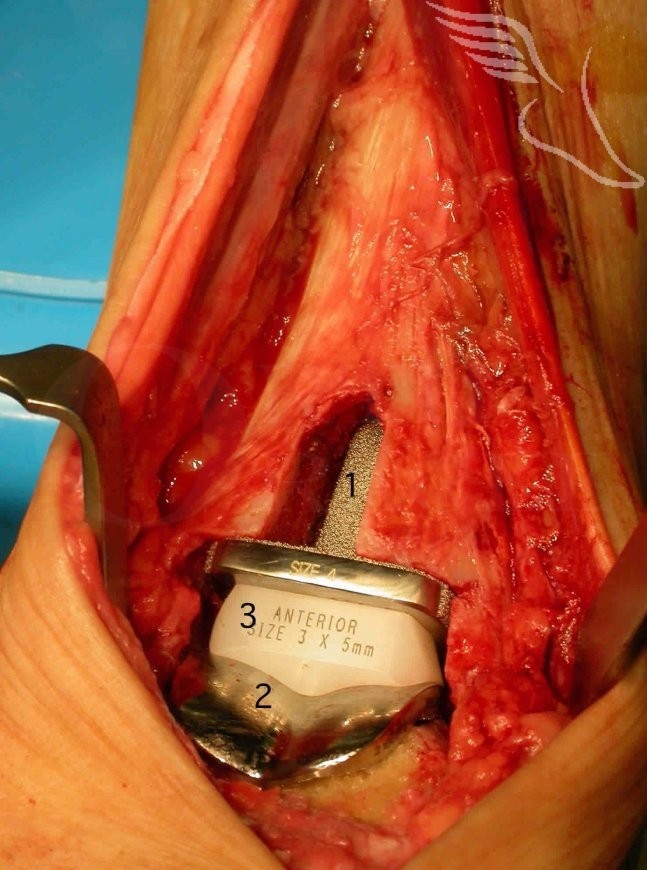
The DePuy mobility ankle replacement implanted with definitive tibial (1) and Talar (2) components and meniscus (3).

The Tibial window replaced(1) with cancellous bone into the drill hole(2).

Range of dorsiflexion after DePuy Mobility Ankle replacement.

The range of plantarflexion after DePuy Mobility ankle replacement.

Pre and post operative A-P xray views of the mobility ankle replacement.

Pre and post operative lateral view of the mobility ankle replacement.
The anterior translation seen here is not an uncommon finding in osteoarthritis. This can effectively be disregarded in the decision making process about whether to replace or not.

How much weight bearing allowed early depends upon the quality of the press fit of components and a Surgeons preference. My own is to limit al weight-bearing for at least 4 weeks with a light weigh cast.This does not have the disastrous effect upon range of movement ( or indeed I think any effect)that one would expect if treating a knee replacement in a similar fashion.The incidence of early post-operative peri-articular fracture is significantly reduced.
Once out of cast follow with a post-operative boot boot , week 7-12 .
Range of movement can be worked upon once anterior wound has healed.
Post operative follow up xrays weeks 6,12 and annually.

Total Ankle Replacement.The results in 200 Ankles.
P.L.R.Wood , S.Deakin .
J Bone Joint Surg(Br).2003;85-B:334-41.
200 uncemented replacements. Mean follow up 46 months. 5 year survival 92.7%
5 major wound problems, 7 ongoing pain & stiffness ,19 fractured malleoli .
A randomised , controlled trial of two mobile bearing total ankle replacements.
P.L.R.Wood, C.Sutton , V. Mishra, R.Suneja
J Bone Joint Surg(Br).2009;91-B:69-74.
RCT of STAR versus Beuchel-Pappas implants. 6 year survivorship 79% BP and STAR 95%.
Not however a statistically significant difference.
Kinematics of a Total Arthroplasty of the ankle:Comparison to Normal ankle motion.
J.D.Michelson, G.R.Schmidt,M.S.Mizel
Foot & Ankle International.Vol.21 ,No 4:
278-284
The management of failed ankle replacement.
J Bone Joint Surg.2006. 88-B:1039-1047.
K.Kotnis , C.Pasapula , F.Anwar , P.H.Cooke ,R.J.Sharpe.


Reference

  • orthoracle.com
Dark mode powered by Night Eye