//

Dupuytrens contracture- Dermofasciectomy and skin grafting

Watch the overview
Learn the Dupuytrens contracture: Dermofasciectomy and skin grafting surgical technique with step by step instructions on OrthOracle. Our e-learning platform contains high resolution images and a certified CME of the Dupuytrens contracture: Dermofasciectomy and skin grafting surgical procedure.
Dupuytren’s disease is a fibroproliferative condition effecting palmar tissues of the hand resulting in contractures of the fingers. It has a genetic predisposition with a variable inheritance pattern. There are several environmental factors implicated in this condition including smoking, alcoholism, diabetes, and epileptic medications. Treatment of Dupuytren’s contractures is indicated mainly for contractures effecting hand function. The treatment is chosen based on several factors including whether it is a primary disease or recurrent; the degree of contracture; patient’s co-morbidities and patient preference.
Dupuytren’s disease is an inherited autosomal dominant trait with variable penetrance and expressivity. Normal fascia is composed mainly of type I collagen. In Dupuytren’s there is an increase of type III collagen (as also seen in wound healing) and myofibroblasts which are a contractile cell derivative from the fibroblast. With this contractile potential, the normal anatomical ‘Bands’ within the hand can become contracted ‘Cords’. In addition to ‘Cords’, ‘Nodules’ are seen when a bulk of Dupuytren’s tissue appears in one site and ‘Pits’ are seen when the skin fibers contract and pull small areas of skin down towards the deeper cords in the palm.
The recognised bands/cords are as follows:
Pretendinous band/cord– a continuation of the palmaris longus and palmar fascia which is in line with each digit and inserts around the flexor sheath at the level of the MCPJ crease (a central cord can continue in this line along the flexor sheath to the DIPJ).
Natatory ligament/cord– transverse cords which span between the web spaces blending with the pretendinous band/cord and spiral band/cord
Spiral band/cord– longitudinal structure superficial to neurovascular bundle (NVB) crossing from pretendinous band/cord to blend with lateral digital fascia, when contracted this pulls the lateral digital fascia/cord centrally and as the NVB is enclosed by Grayson’s and Cleland’s ligaments which are attached to the lateral digital fascia the NVB is then pully more centrally in the finger at the level of the MCPJ crease.
Lateral digital fascia/cord– longitudinal structure close to the skin running almost up the lateral midlines of the fingers attached to Grayson’s and Cleland’s ligaments.
Retrodigital fascia/cord – distal continuation of lateral digital fascia/cord which may cause DIPJ contracture.
Commisural band/cord– similar to Natatory but of the 1st web space
Legueu and Juvara septa/cord – vertical structures which separate the distal palm into sections with NVB and lumbrical then flexor sheaths in alternating sections.
Grapow fibre/cords– small vertical structures which tether the palmar skin to the deeper fascia and provide stability of the skin and cause pitting when contracted.
The treatment options for this condition include Needle aponeurotomy, Collagenase injection(though the drug has been currently withdrawn from the market), limited fasciectomy, segmental fasciectomy, and dermofasciectomy.
For a recurrent disease where there is the involvement of the skin, a Dermofasciectomy is recommended as it has the lowest recurrence rate. This procedure involves excising the segment of skin involved in Dupuytren’s disease and replacing it with a full-thickness skin graft from the forearm. This however carries a risk of graft loss in which case the wound has to be allowed to heal by secondary intention.
Adjunctive procedures apart from excision of the Dupuytren’s cords are sometimes required for these patients. When there is a contracture of the PIP joint which does not straighten by manipulation of the finger a sequential release of the joint can be attempted. This involves a release of the flexor sheath, release of the proximal attachment of the volar plate, and release of the accessory collateral ligaments. Release of the true collateral ligaments is not recommended as this causes instability and stiffness of the joint
With long-standing contractures of the PIP joint, the central slip may get attenuated resulting in a Boutnonnierre deformity. This is clinically seen as a flexed PIP joint and a hyperextended DIP joint. In these cases after the contractures are released with or without a joint release, full passive straightening is achieved but a tenodesis test(flexing the patient’s wrist extends the fingers suggesting the integrity of the tendon) will be negative. In these cases there may be a consideration for a central slip tightening procedure. This can be done by reattaching the attenuated central slip using a bone anchor or by doing a ‘Chamay’ incision and advancing the tendon proximally as can be seen in this case.
This case illustrates a recurrent Dupuytren’s disease affecting the left little finger in a middle-aged man. The primary procedure was a limited fasciectomy carried out 10years ago. There is noted recurrent disease and progression of the disease into the finger causing an MCP joint contracture of 30 degrees and a PIP joint contracture of 80 degrees. There is hyperextension of the DIP joint suggesting an attenuation of the central slip. The palmar skin is scarred and indurated suggesting its involvement by the disease. After a detailed discussion, a decision has been made to perform a dermofasciectomy with full-thickness skin grafting. The adjunctive procedures planned are PIP joint release and a central slip tightening.
Readers will also find the following OrthOracle techniques of interest:
Palmar and digital fasciectomy for Dupuytrens
Limited fasciectomy for Dupuytrens disease plus Z-plasties
Collagenase (Xiapex) injection and Manipulation for Dupuytrens contracture

Indications
A patient will present for treatment usually for one of three reasons:
1.They have lumps in the palm and are unsure of the diagnosis. These patients can be reassured based on a clinical diagnosis, educated on the condition, and discharged.
2.They are aware of the diagnosis and the tightness of the palm or nodules are a nuisance but no clear fixed flexion deformity – these patients are best educated about the condition and the likely recurrence rates and therefore avoidance of very early surgery to avoid scarring and increased future complications of repeat surgery. If they still would like intervention in specific cases (e.g. professional pianist whose span is reduced or tree surgeon with large nodules but no contracture making gripping difficult and climbing unsafe – reasonable surgical indications) they have two options in the UK. One is to have treatment in the private sector and the other is for the surgeon to apply for specific funding on individual grounds for the treatment to the funding body.
3.The patient has a contracture of the digit causing dysfunction. In the UK patients can undergo funded treatment for Dupuytren’s contractures based on certain guidelines. In the author’s region this states if there is a progressive PIPJ contracture or an MCPJ contracture of 30 degrees or more then treatment can proceed. These values are often the point at which dysfunction is increasing due to the contracture.
Symptoms
Dupuytren’s disease is a non-painful condition. Although the condition can be itchy or sore when active proliferation is taking place, or painful when gripping if large nodules are compressed, if pain is a main feature of the presentation then a rare but serious diagnosis of fibrosarcoma should be excluded.
Dupuytren’s contracture is a spectrum of severity and can range from a mild inconvenience to a disabling condition with all ten digits severely affected.
Patients complain of aching or cramping in the hands, a feeling of tightness, and the inconvenience of the contracted digit of poking then in the eye when washing their face, catching on their clothes when trying to get money out of their pocket, and sticking on door handle after they have opened them.
The Dupuytren’s diathesis is a collection of signs and conditions which are seen to suggest a worse prognosis in terms of disease progression and recurrence. This is made up of age <50, male, bilateral disease, radial-sided disease (thumb/index finger), family history, and ectopic disease. Ectopic sites include the dorsal PIPJ nodules (Garrod’s pads), penile fibrosis (Peyronie’s disease), plantar fibrosis (Lederhose’s disease).
Examination
The inspection usually reveals cords, nodules, and pits within the palms and fingers.
It should be noted from the history which specific fingers are troubling the patient, especially in the more severe disease when all fingers are affected and multiple treatments and recurrences have already occurred.
Joint contracture angles should be measured and recorded and it is useful to isolate each joint and record the combined and individual joint contractures. This is performed with a small finger goniometer on the dorsum of the finger. Initially, the whole finger is extended maximally and the joint angles recorded. Following this the MCPJ is fully flexed and PIPJ maximal extension is recorded then the PIPJ is maximally flexed and the MCPJ extension angle recorded.
This differential will help the surgeon identify if there is a spanning cord contracting both joints and help with prognosis to predict the postoperative correction.
As a general rule, all MCPJ contractures caused by Dupuytren’s no matter how severe will be corrected by treatment. Any PIPJ contracture above 60 degrees is likely to remain with some contracture post-treatment. This is due to the collateral ligament and volar plate contractures which can be released intra-operatively to provide a greater extension but at greater risk of joint stiffness, and loss of flexion.
After previous surgery a digital Allen’s test (as for Allen’s test at the wrist the finger can be squeezed by the examiner to exsanguinate and both digital arteries pressed upon and released one at a time first starting with Radial then on the second time starting with the Ulnar. The rate of reperfusion should be noted and if a significant difference noted between sides then a possibility of previous arterial injury should be considered) and assessment of sensation are also useful to record if further intervention is being planned.
Further examination of ectopic sites can be undertaken if necessary although usually only the dorsal PIPJ disease of Garrod’s pads is reviewed.
Investigations
There are no formal investigations for Dupuytren’s disease unless there is a concern regarding pain and a possible diagnosis of sarcoma. In this case a USS or MRI may be performed. This may also be necessary in an isolated nodule where diagnosis is unclear.
Non-operative Management
The best non-operative treatment is patient education and reassurance which includes advice on the stage of disease progression in which treatment is advised.
Non-operative management with splinting or physiotherapy has not shown to be effective. Radiotherapy is one option used to prevent disease progression however the evidence on its effectiveness is limited. The author does not use this in their treatment pathway.
Alternative operative Management
For primary disease involving MCP joint a needle aponeurotomy, collagenase injection, or a limited fasciectomy can all provide a good correction. However, the risks of the procedure and the recurrence rates vary.
Needle aponeurotomy: Low risk, recurrence rate up to 50%
Collagenase injection: Risks of skin tear and a very small risk of tendon injury, recurrence rate 30-40% Collagenase is currently not available in the market.
Limited fasciectomy: Risk of digital nerve injury(2%); recurrence rate 20-30%
It is important to note that recurrence rates do not equate to re-operation rates. The exact figures for re-operation for individual techniques are not available but are much less than the recurrence rates as many patients opt not to have a repeat operation and choose to accept the deformity.
Contraindications
A relative contraindication to a dermofasciectomy is multiple previous surgeries with rapid recurrence when alternative treatment options such as joint arthrodesis or amputation may be a better consideration.

This procedure can be performed under a Brachial block or General anesthesia. It is important to have a complete blockage of the arm if using a Brachial block to ensure that the area from where the skin graft is harvested is numb.
The procedure is carried out under loupe magnification.
The patient is in a supine position with the arm on a hand table. The surgeon and assistant sit down on either side of the arm.
As the procedure takes more than one hour, it is better to inflate the tourniquet just before making the incision to minimise the discomfort from the tourniquet.

Hand is positioned in a Lead hand
This operation is performed under a Brachial block. A single dose of pre-operative antibiotic is given intravenously.
The arm is prepped and draped and positioned on a Lead hand as shown. A Huck towel is placed under the hand to pad the undersurface and to absorb any wash fluid.

A close up of the hand showing the contracture and scarring in the palm can be seen.
This that the contracture which affects mainly the PIP joint. The DIP joint is hyperextended. The scars of the previous operation can be seen. There is induration of the palmar skin suggesting involvement with Dupuytren’s tissues.

Surgical incision is marked over the midline of the finger and palmThe incision is marked. The incision in the finger extends to the pulp, about 2cm distal to the DIP joint. It is important to extend the incision beyond the area of contracture to identify the neurovascular bundles away from the diseased area.
The proximal incision is marked as a chevron. In this case, the excision is extended to the middle of the palm as the contracture can be felt up to that area. The straight incision in the finger will later be converted into a z-plasty.
The proposed area of skin excision is marked as a rectangle. The decision on how much skin to excise and were to excise has to be made during the operation. The classic teaching is to do the skin excision as a rectangle over the proximal phalanx as it interrupts the disease between the palm and the finger and as it is on a non-mobile part(between the two joints), there is a good chance of graft take. However in this case I have chosen to do the skin excision in the palm for two reasons:
1. The area of scarring is mainly in the palm.
2. I am planning to do a PIP joint release and once I have done it, you will have exposed flexor tendon and a skin graft may not take over it.

Arm is exsanguinated using Esmarch’s bandageAn Esmarch’s bandage is used to exsanguinate the arm prior to inflating the tourniquet.

Skin incision is made, proximally as a chevron, then rectangle and then longitudinally in the mid-axis of the digit The incision is started using a No.15 blade along the marked lines.

Dissecting through the scarred tissues is not easy. The key is to use skin hooks on either side of the incision which provides traction to facilitate the dissection.

Dissection is continued using the scalpel. It is not easy to dissect through scarred tissues using scissors. A pushing action using the knife is the easiest way to separate the tissues.

Skin flaps are raised exposing the cordsSkin flaps have been raised exposing the Dupuytren’s cords. As it is a recurrent contracture the cords are not as distinct as one would see in primary disease.

The initial cord one comes across, lying directly over the flexor sheath, is the pretendinous cord, which is divided in the palm.This would have been previously excised in the initial operation and is a recurrent cord. This cord is sharply divided using the scalpel.

The divided cord is held using an artery forceps and traction applied to help with further dissection.

A transverse band of scar tissue is divided to help identify the neurovascular bundle on the radial side.

Loupe magnification is essential for this operation. I have used a 3.5X Expanded field loupes but a 2.5X loupes is sufficient. Dissection is done using scissors to identify the neurovacular bundles. The neurovascular bundles lie in the palm on either side of the flexor sheath with the nerves in the middle and artery and vein on either side. In primary disease, it is relatively easy to find them on either side of the cord which lies over the flexor tendon. Here there is scar tissue in the surrounding tissues and it is important to dissect gently to avoid injury these structures.
It is important to identify both the neurovascualar bundles in every case of Dupuytren’s disease and preserve them. There is a risk to the artery and nerve while dissecting the cords and every care has to be taken to avoid it.

The digital nerve on the radial side is identified in the palm. It appears tortuous as it has been lying entangled in the scar tissue. It is important to identify the neurovascular bundles in the palm away from the scar tissue and trace it distally.

Neuorvascular bundles are identified on either side of the digit Similarly, the digital nerve on the ulnar side is dissected free of the scar tissue.
A: Ulnar side digital nerve

Cord is dissected outThe previously divided cord is now dissected further in the finger using blade.

While dissecting the cord care has to be taken to presreve the flexor sheath. This is not so much a problem while doing primary Dupuytren’s surgery but as it is a recurrent disease the scar tissue can make dissection difficult.
The key is to use a sharp knife dissection and to keep the cord under tension while dissecting. A pushing action using the blade is the safest way to dissect avoiding injury to the flexor sheath.

Cord is excisedThe cord has to be dissected free up to the DIP joint. It is important to keep the neurovascular bundles under vision all the time.
The cords start in the palm and can extend upto the DIP joint. They lie in several planes in the finger sometimes displacing the neurovascular bundles. Broadly speaking the cords are:
Pretendinous cord: Lies in the midline over the flexor sheath in the palm.
Central cord: Lies in the midline over the flexor sheath in the finger.
Lateral cord: Lies on either side of the neurovascualr bundle in the finger
Retrovascular cord: Lies posterior to the neurovascular bundles in the finger.
Spiral cord: Combination of a pretendinous cord and a retrovscular cord which displaces the neurovascualr nundle to the centre.

The flexor sheath and neurovascular bundles on either side can be seen.

A schematic representation of the pulley system can be seen here.

A gentle manipulation of the finger is done to straighten the PIP joint, following the initial releases.This is done as shown using both the hands. Care must be taken not to use undue force or else you can fracture the proximal phalanx.
In cases where there is no PIP joint contracture, this step will give a full correction. In cases where there is a joint contracture, this may give a partial straightening.

Whilst there is an improvement in contracture, the finger is not fully straight. There is a 30-degree residual contracture of the PIP joint. This is due to a joint contracture. At this point, a decision has to be made as to whether to attempt a joint release or accept the residual contracture. A 30 degree PIP joint contracture can be accepted if the MCP joint is fully straight. In this case, a decision to release the PIP joint has been made as the patient was keen to have the finger as straight as possible.

Schematic representation of the contracted PIP joint can be seen here.
It is important to understand the pathology of a contracted PIP joint. As one can see in this picture, the PIP joint is flexed. This causes the volar plate(1) to migrate proximally. It gets tethered to the proximal phalanx and if attempted to straighten it the proximal attachment stands out like a string and is called a ‘check-rein ligament’.
There are two sets of ligaments stabilising the joint on either side. One is the true collateral ligament(2)which is attached from the proximal phalanx to the middle phalanx. The other is called accessory collateral ligament(3) and are attached from proximal phalanx to the volar plate.
These ligaments shorten if the finger is kept in flexion for a long time. The third change is the attenuation of the central slip(4)on the dorsum. Even if the check rein ligaments and the accessory ligaments are released, the patient may not be able to actively extend the finger due to the slack in the central slip. This can be demonstrated during the operation.
After the joint release one can passively fully straighten the joint. However if one does a tenodesis test by flexing the wrist, all the normal fingers extend at the PIP joint but the one with the attenuated central slip will remain flexed.

A3 pulley is divided and lifted as a radially based flapHere the decision has been made to do a joint release.
An Alm’s retractor is placed on the soft tissues as shown. The A3 pulley(the flimsy pulley over the PIP joint) in incised and lifed off as a radially based flap.

The flexor tendons are retracted using a Ragnall retractor as shown. The white structure underneath is the volar plate.

The volar plate is divided over its inferior attachment to proximal phalanxThe inferior attachment of the volar plate on the proximal phalanx is divided using a No.15 blade. Next, the accessory collateral ligaments are incised on either side. The schematic illustration can be seen in the next picture.
The true collateral ligaments are attached between the head of the proximal phalanx and the base of the middle phalanx. The accessory collateral ligaments are attached between the head of the proximal phalanx and the sides of the volar plate. The check rein ligaments are the inferior attachments of the volar plate on the middle phalanx.

Gentle manipulation of the finger is attempted again allowing almost full straightening of the finger.

The straightened finger is placed in a Lead hand. As can be seen a rolled gauze is placed under the finger to maintain the extension.

Z-platies are designedThere is tightness of the skin which should be addressed. A z-plasty is planned as shown.
The angles of the z-plasty are 45 degrees and the flaps are centred over the proximal phalanx. The flaps are extended to the mid-lateral lines. They are raised as full thickness skin flaps. There are no hard and fast rules about the number or location of z-plasties. Generally, one to two z-plasties are performed. One performs Z-plasties to get the skin tension relieved while straightening the finger. If the finger is fully straight and skin lies tension free with one z-plasty it is sufficient. Otherwise a second z-plasty is done.

Once the z-plasties are made, the flaps are transposed and sutured using 4-0 vicryl rapide. Transposition of the flaps essentially mean that they swap places. The flap on the ulnar side comes to the radial side and vice-versa.

The completed z-plasty with sutured flaps can be seen. There is no tension on the skin.

The rest of the wound closure in the finger is completed. Note that the area marked for skin excision is still not removed.

Dorsal longitudinal incision is made over PIP jointAn important decision has to be made at this point. It was noted during the pre-op assessment that the patient had an extensor deficit over the central slip with a Boutonniere deformity. This is due to attenuation of the central slip with the long-standing contracture and if not addressed will result in a recurrence of the joint contracture.
A central slip tightening procedure can address this, though there is a risk of losing flexion in the finger if it gets scarred. The alternative is to use a splint for the PIP joint for four weeks with the hope that the tendon shortens over time. I have tried this in the past with less success and now has adopted a technique for shortening the central slip.
The hand is turned over and placed on a rolled-up Huck towel. A longitudinal incision is made over the dorsum of the PIP joint of the finger.

An Alm’s retractor is used to retract the soft tissues. The stretched out central slip can be seen.

A V shaped Central slip incision is marked, and then a V shaped central flap raised with the apex of the V proximally located A long V incision is marked on the central slip as shown. The apex of the V stops two-thirds the length of the proximal phalanx.

This V flap is incised and lifted as shown.
The finger is straightened out and while the assistant is holding it extended, the tendon is closed. While doing this the V flap is advanced proximally shortening the tendon.

Central slip is tightened by suturing the V-flapOnce the tendon is sutured there will be a small redundant segment proximally. This can be excised or sutured down to the rest of the tendon.

The skin over the dorsum of the finger is closed with 4-0 vicryl rapide.

The finger is turned over again and positioned in the lead hand.

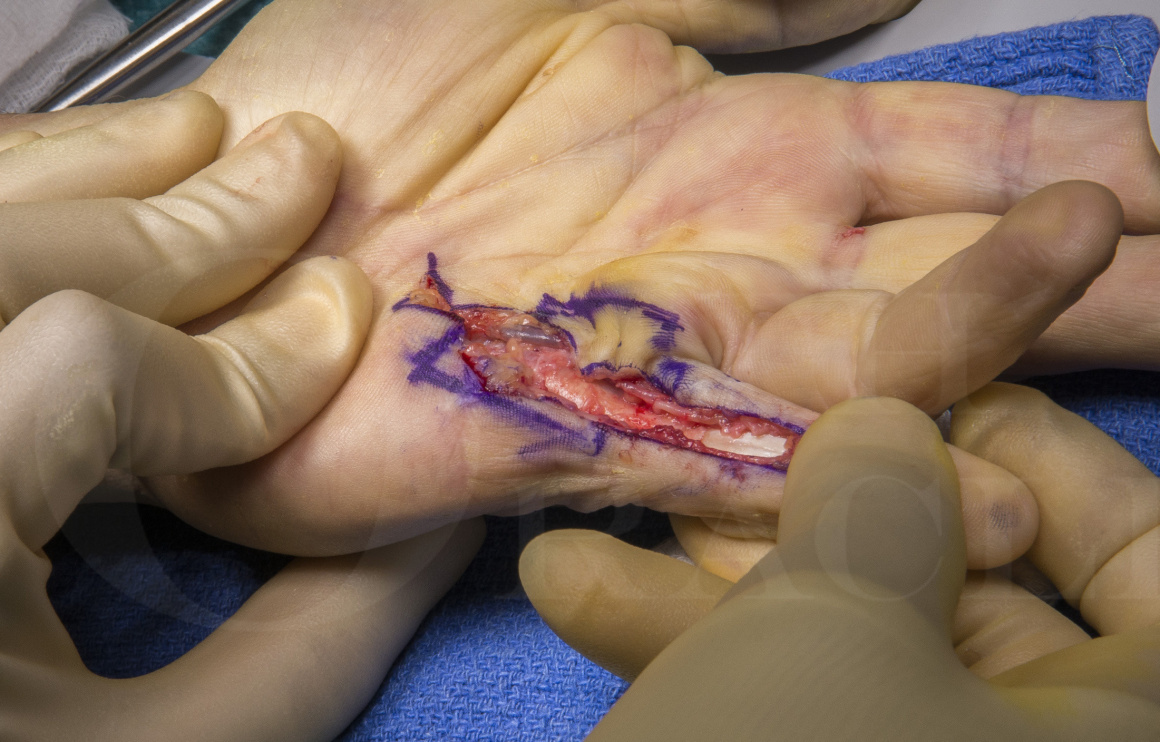
The rectangular palmar skin is excised once all corrections are completed.The marked out rectangular area of skin is excised. The area of skin excision is where there is the involvement of the skin from previous scar tissue and recurrent disease. In this case, it is a small rectangular area over the palm. In cases where it is over the finger, a similar area is excised from the proximal phalanx.
The reason for the excision of the skin is to get rid of the skin which has Dupuytren’s tissue and thereby reduce the risk of recurrence.

The tourniquet has been released as this stage. It is important to release the tourniquet prior to applying the skin graft.
The area of skin excision is shown. The entire marked out area has not been excised. This is because doing so will expose the digital nerves and arteries proximally. Whilst it is possible to skin graft over nerves and vessels sometimes it can give a sensitive scar.

Skin graft template is marked out over the defect createdA template of the defect is taken using a piece of sterile paper which can be available from the underlay of the instrument tray.

The template is cut into the required shape.

It is placed over the defect to check that it fits the defect. It is important that the template matches the size and shape of the defect. Unlike a split skin graft a full thickness skin graft takes its blood supply from the edges of the wound and the base and it is important to have contact with the skin edges.

The skin graft is marked on the medial aspect of the forearm. A hairless part of the skin away from the tattoos is chosen for the skin graft.
A full-thickness skin graft contains hair follicles and can grow hair on the donor site. Likewise, tattoos can be transferred to the donor site with the graft. Two triangles are marked beyond the rectangular template which is to create an ellipse. This avoids a dog ear while closing the skin.

Incision is made along the marked line.

Full thickness skin graft is harvested from a hairless part of the forearm, as an ellipse to allow easier closure.An artery forceps is applied to the skin edge and traction is applied while the skin graft is sharp dissected free.

This shows the donor defect after the skin graft has been harvested, which is then closed.

The skin graft is defatted using a tenotomy scissors. Keeping a moist swab nearby helps to clean the scissors in between dissections. It is important to remove all the fat from the graft down to the white dermis. This is to ensure that there is contact between the dermis and the wound to enable vascularisation of the skin graft. If there is fat on the undersurface of the graft, it will act as an interposition and prevent graft vascularisation.

The skin graft is placed over the defect.

Skin graft is securedThe graft is sutured to the wound using interrupted 4-0 vicryl rapide sutures.

The closed donor site is seen.

Once the graft has been fully secured a few additional long 4-0 vicryl rapide sutures are placed along the edges of the graft. These are to do a tie-over dressing to secure the graft.

About 6 to 8 sutures are placed along the edges of the graft.

Tie-over dressing is applied over the skin graftA rolled piece of Jelonet is used to do the tie-over.

The rolled up Jelonet is placed over the graft.

The long vicryl rapide sutures are tied over the graft.

The tie-over dressing is completed.

Another Jelonet dressing is used over the rest of the finger.

Gauze dressings are applied.

Velband and a POP volar slab are applied.

The POP is moulded to keep the wrist and fingers extended.

A bandage is applied.

The hand is elevated in a Bradford sling.
The patient is discharged home on the same day with oral analgesics.
The arm should be kept elevated during the post-operative period in a sling. The patient is advised not to use the hand for any activity.
The wound is checked in five days. The graft should be adherent to the wound with no discolouration.
A light dressing is applied and a hand based splint is made to keep the finger in extension for three weeks more. After that active flexion exercises are started and the splintage continued for the night time. The patient is advised to moisturise and massage the graft and the scars. After six weeks gentle passive exercised are started. This is continued for another six weeks. At the end of it patient should have regained flexion in the finger. The night splint may be discontinued if patient has a full active extension. The patient is followed up again at three months to check for any flexion deformity. There is any evidence of it night splintage is recommenced for another six weeks. The final review is done at six months.

1. Wade R, Igali L, Figus A. Skin involvement in Dupuytren’s disease. J Hand Surg Eur Vol. 2016;41(6):600-608.
This study looked at the skin histology of patients with Dupuytren’s disease. It was found that there was dermal involvement in 50% of patients undergoing fasciectomy and 70% of those undergoing dermofascietomy. Skin involvement was associated with greater pre-operative contracture, palmar nodules, and occupations involving manual labour. The authors hypothesised that skin has a greater role in the development of the disease than previously thought.
2. Ketchum LD. The use of the full thickness skin graft in Dupuytren’s contracture [published correction appears in Hand Clin 1992 May;8(2):followi]. Hand Clin. 1991;7(4):731-743.
This review article outlines the treatment options of Dupuytren’s disease including limited fasciectomy and dermofasciectomy. The role of dermofasicetomy and skin grafting is discussed with the benefit of low recurrence.
3. Ullah AS, Dias JJ, Bhowal B. Does a ‘firebreak’ full-thickness skin graft prevent recurrence after surgery for Dupuytren’s contracture?: a prospective, randomised trial. J Bone Joint Surg Br. 2009;91(3):374-378.
This is a randomised controlled trial which looked at the role of full-thickness skin grafts used as a fire break in minimising the risk of Dupuytren’s disease. These were patients who could have limited fasciectomy and skin closed without any problems. There was no significant difference between outcomes and the recurrence rate was 12.4%. It is important to note that these were not patients with recurrent disease and skin involvement.


Reference

  • orthoracle.com
Dark mode powered by Night Eye