
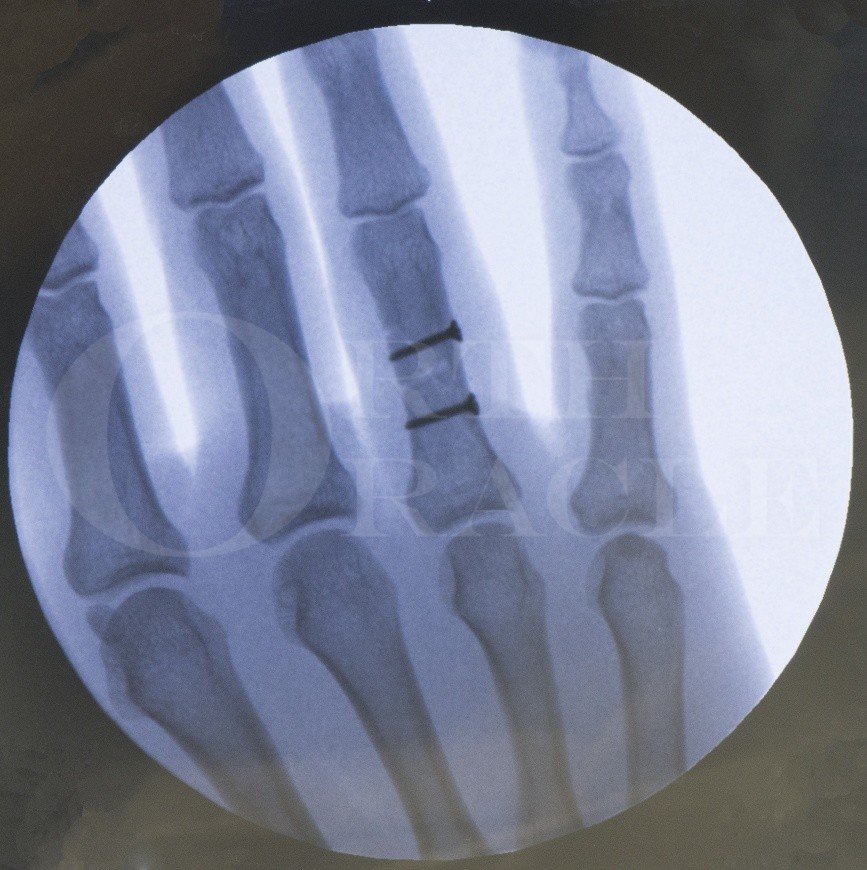
Learn the Lag screw fixation of a proximal phalanx fracture using Synthes® 15 mm Compact Hand Set surgical technique with step by step instructions on OrthOracle. Our e-learning platform contains high resolution images and a certified CME of the Lag screw fixation of a proximal phalanx fracture using Synthes® 15 mm Compact Hand Set surgical procedure.
Proximal phalangeal fractures are fairly common, with their incidence being second only to the metacarpal fractures in the hand. Malunion of these fractures can result in scissoring of the fingers or pseudoclawing, which interfere with the normal function of the hand. Reduction, stabilization and early mobilization are essential for optimal outcomes following this injury.
Readers will also find of interest the following OrthOracle technique Internal Fixation of Proximal Phalanx with Synthes® 1.5 mm Compact Hand Plate

INDICATIONS
Strickland et al recognized that reduction and stability of the fracture along with length of immobilization are directly related to digital performance. Rigid stabilization allows immediate early mobilisation of the digit. I believe that the indications for internal fixation of proximal phalangeal fractures with lag screws are:
Open injuries
Fracture associated with tendon, ligamentous or neurovascular injuries
Malrotation or angular deformity of the digit. (No angular or rotational deformity is acceptable for full functional recovery.)
Displaced intra-articular fractures
SYMPTOMS & EXAMINATION
Proximal phalangeal fractures occur following an episode of trauma. This may involve a fall on the hand, a blunt impact on the finger or a twisting injury to the finger. It may also be seen in patients involved in significant polytrauma. Unlike the metacarpal neck fractures, phalangeal fractures do not always result from punching injuries. They are usually isolated injuries but may occasionally be present in multiple digits. There is no age predeliction for these injuries. The injuries are equally distributed between dominant and nondominant hands.
The patient presents with a painful, swollen and often deformed finger. The finger should be examined for any rotational or angular deformity on presentation. Malrotation is assessed by noting any scissoring of fingers on attempted flexion. Comparison should always be made with the contralateral side. Associated injuries to the tendons and neurovascular structures should be identified. Definitive diagnosis is based on radiographic evaluation.
IMAGING
Plain radiographs in AP and lateral plane are usually sufficient to identify the fracture pattern and displacement. Special views are usually not required to identify the injury or plan management.
A true lateral view is essential in confirming the displacement. Angular and rotational deformities are dependent on the original deforming force of the trauma. Intra-articular extension of the fracture should be identified on the radiographs. Any comminution of fracture fragments should be identified.
ALTERNATIVE OPERATIVE TREATMENT
Manipulation and splintage: This is useful for stable fractures only. However, the reduction needs to be monitored closely with serial weekly radiographs. In addition, the prolonged immobilization required to maintain reduction can be counterproductive for regaining finger function.
Closed reduction and K wiring: This provides better stability and is useful for unstable fractures. Multiple K wire configurations have been described in literature with varying results. Belsky wiring, Single intramedullary wires and crossed K wires have all been shown to have complications of infection, stiffness and metalwork failure. In addition, K wires do not provide rigid stability to allow immediate mobilization. They are also not appropriate for comminuted fractures and for those involving bone loss.
Internal fixation with plates: Although this provides good rigid stabilisation, the procedure carries an inherent risk of increased tendon adhesions and stiffness. The technique is best reserved for comminuted fractures, segmental fractures and those involving bone loss.
NON-OPERATIVE MANAGEMENT
Non-operative management should be considered and discussed with the patient. Patient buy-in for the rehabilitation process is extremely crucial for a successful outcome and should be reiterated before planning definitive management for these injuries. Manipulation and splintage is a viable alternative proposed by a number of authors in the literature. The finger needs to be splinted with the MCPJ in flexion and the PIPJ in varying degrees of extension to reliably maintain the fracture reduction. Serial radiographs followed by intensive physiotherapy, to overcome the resultant stiffness, are the mainstay of a nonoperative treatment method.
CONTRAINDICATIONS
The main contraindication for this procedure is a multifragmentary fracture configuration with or without bone loss. These require alternative modes of fixation (plates and screws or external fixators) to achieve adequate stability. Other contraindication for definitive fixation is a patient who is not fit for anaesthesia and surgery. However, in my experience, an unsure patient who carries misgivings about any surgical intervention, is a relative contraindication for internal fixation.

Informed consent is an important part of the procedure and the risks and benefits should be clearly explained to the patient. The metalwork lies in close proximity to the articular surface and the extensor tendon. The patient should, therefore, be always counseled regarding the risk of tendon adhesions and stiffness necessitating removal of metalwork after the fracture is healed.
I prefer regional anaesthesia with axillary block for this procedure. The patient is placed supine with the limb extended on an arm table. Upper arm tourniquet is applied and inflated after exsanguination. A prescrub is performed followed by a sterile prep with Chlorhexidine. A lead hand is used to stabilize the hand. I routinely administer a single dose of antibiotics for this procedure


The dressings are reduced in the clinic in 48-72 hours. Active mobilization exercises are commenced at this stage along with gentle passive exercises. Special emphasis is needed to mobilise the MCP and PIP joints. A splint is usually not required.
Sutures are removed in 2 weeks. Gentle routine activities of daily living can be started as soon as comfortable. Rigorous and heavy activity is avoided.
Radiographs are repeated at 6 weeks. Once the fracture healing is confirmed, aggressive passive exercises can be instituted. Activities of daily living can be increased at this stage. I advise patients against heavy activities for atleast 3 months until the fracture is consolidated.
Tendon adhesions and stiffness remain the main complication of the procedure. Stern et al (1987 and 1988) confirmed that stiffness was the most common complication of this procedure. An extensor lag at the PIPJ, which is correctible passively, signifies extensor tendon adhesions. Reduced range of active flexion as compared to passive flexion signifies flexor tendon adhesions – and may be due to incorrect screw lengths protruding out of the volar cortex. Tendon adhesions may require tenolysis, which is best delayed for 3 months so as to allow the fracture to fully consolidate.

The results reported in the literature of phalangeal fractures treated with internal fixation are scarce and contradictory. However, the following may help the reader start on the journey of exploring the efficiency of internal fixation in phalangeal fractures:
Strickland JW, Steichen JB, Kleinman WB, et al: Phalangeal fractures: factors influencing digital performance, Orthop Rev 11:39-50, 1982.
One of the early reports on predictive factors of outcome following this injury.
Shimizu T, Omokawa S, Akahane M, Murata K, Nakano K, Kawamura K, Tanaka Y. Predictors of the postoperative range of finger motion for comminuted periarticular metacarpal and phalangeal fractures treated with a titanium plate. Injury. 2012 Jun 1;43(6):940-5.
A recent report on predictors of outcome. The authors concluded that increasing age and soft tissue injury were significant predictors of stiffness following internal fixation with plates and screws. The same center, in an earlier publication (2008), concluded that plating of phalangeal fractures was highly efficient in maintain reduction and resulted in reasonable outcomes with few complications.
Miller LG, Ada L, Crosbie J, Wajon A. Time to commencement of active exercise predicts total active range of motion 6 weeks after proximal phalanx fracture fixation: A retrospective review. Hand Therapy. 2017 Jun;22(2):73-8.
A retrospective review of 49 fractures showed that the time to commencement of active exercises was the single independent predictor of total range of movement at 6 weeks. The authors concluded that K wire fixation delayed the exercises by atleast 2 weeks, resulting in poorer outcomes than those treated with open reduction and internal fixation.
Lundin M, Woo E, Hardaway J, Pratt CK, Clarkson JH. The cost of quality: Open reduction and internal fixation techniques versus percutaneous K-wire fixation in the management of extra-articular hand fractures. Journal of Orthopedic Surgery and Rehabilitation. 2017;1(1).
The authors concluded that that open reduction and internal fixation had better outcomes and fewer complications as compared to percutaneous K wire fixation. However, the numbers of proximal phalangeal fractures included in the study were very small – (8 K wire fixations and 4 internal fixations)
Johner R, Joerger K, Cordey J, Perren SM. Rigidity of pure lag-screw fixation as a function of screw inclination in an in vitro spiral osteotomy. Clinical orthopaedics and related research. 1983 Sep(178):74-9.
This article measures the rigidity of lag screw fixation in experimental anatomical tibial models. The authors concluded that the stability offered is strong enough to withstand the pressures of load bearing and can replace plate fixation in spiral fractures.


